

We have all been there: trapped in a loop with a rigid chatbot, repeating our query in slightly different ways, only to get the same “Sorry, I didn’t understand.” Poor conversational design like this one is a business liability that breeds frustration and inflates support costs.
We champion a more human-centric approach to conversational UX. When done right, it transforms an automated interaction from a roadblock into a low-friction experience. This discipline is about applying the psychology of human conversation to machine interfaces, ensuring they are intuitive and helpful.
At Fireart, we see it as both a design and a branding challenge. For Replicant, a leader in conversational AI, we built a brand identity that projected competence and empathy. To start, we created a persona for their “Thinking Machine™” which communicates with the human tone required to win high-stakes enterprise deals.
In this article we will explore the core conversation design principles. These should be the groundwork for every human-facing chatbot.
Article highlights
- Conversational design is a financial lever. By focusing on KPIs like Containment Rate in tandem with customer satisfaction, businesses can reduce operational service costs by up to 30% while improving brand loyalty.
- Effective conversational AI is rooted in human psychology. Principles like progressive disclosure (revealing information in steps) and the cooperative principle (being direct and relevant) dramatically increase task completion rates.
- The true test of a conversational system is how it handles errors. A resilient interface uses a repair loop to recover from misunderstandings, offering users a simple fix or an escape hatch instead of trapping them in a dead end.
- Even advanced AI can fail due to poor design. Mismatching tone to situation, or trying too hard to fake human emotion damages brand perception and drives user abandonment.
Ready to build human-like interfaces? Fireart can design conversation flows that delight users and increase bottom line.
Explore our Product Design ServicesWhy conversational design is a KPI, not a feature
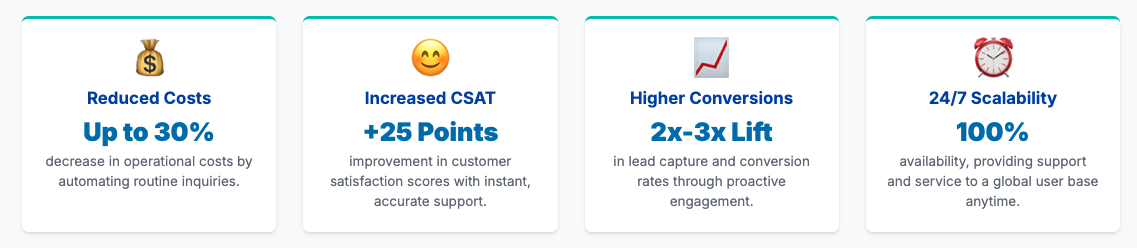
Investing in conversational design makes your chatbot sound friendlier; the cool spin on it is that it boosts business outcomes. Good conversational AI is a powerful financial lever.
Gartner projects that by 2029, agentic AI will autonomously resolve 80% of common customer service issues without human intervention, leading to a 30% reduction in operational costs. Instant, low-friction support at the precise moment a user needs it is what will get you to these numbers.
Containment rate
The most critical KPI to look at is the containment rate: the percentage of customer interactions that are fully resolved by the automated system without needing to escalate to a human agent.
A high containment rate correlates to reduced operational overhead. However, it shouldn’t be viewed in isolation.
It is easy to ramp it up by simply making it impossible for users to reach a human. It might look good on a spreadsheet, but it infuriates customers and destroys brand loyalty.
True success is high containment and high customer satisfaction (CSAT). This is the goal of conversational design: to create an experience so efficient and helpful that users prefer the automated solution. That brings key benefits of conversational design – cost savings, higher conversions, and improved loyalty.
Psychological drivers of engagement

The best conversation design principles are rooted in the psychology of human interaction. A successful chatbot or voice assistant respects the rules that make communication efficient.
Progressive disclosure
Don’t overwhelm the user. Reveal information in gradual steps. This reduces cognitive load.
How to create effective conversational experiences? Avoid asking too much information at once. Best practices for conversational UI design prevent this cognitive overload. Consider a banking bot handling a transaction dispute:
| Before (High Friction) |
|---|
| “To file a dispute, I need the transaction date, merchant name, amount, reason, and the last four digits of the card used. Please provide all of this information.” |
This forces the user to find and type five separate pieces of information, often causing them to abandon the task.
| After (Low Friction) |
|---|
| “I can help with that. First, what was the date of the transaction?” |
By requesting one piece of information at a time, the bot guides the user through a clear, step-by-step flow. This change increases task completion by making a complex process feel manageable.
The cooperative principle
All conversations operate on an implicit assumption of cooperation. We expect responses to be truthful, relevant, and concise. When an AI violates these rules, it breaks trust.
Imagine asking a retail bot about its return policy:
| Before (Uncooperative) |
|---|
| “People love our products! We sell a lot of them. Returns can be made, and we also have a great loyalty program you should sign up for. Our stores are open from 9 AM to 9 PM.” |
This response is irrelevant and verbose, forcing the user to parse out the needed information.
| After (Cooperative) |
|---|
| “You can return most items within 30 days with a receipt. Would you like to know about any exceptions, like final sale items?” |
This answer is direct, concise, and anticipates the user’s next logical question. Improving user interaction with conversation design means ensuring the AI respects the user’s time by providing direct value, which makes the brand feel competent.
Context & disambiguation
An intelligent system must remember what was just said (context) and ask for clarification when a request is ambiguous (disambiguation). This distinguishes a helpful assistant from a rigid script.
Consider a smart home assistant:
| Before (No Context) |
|---|
| User: “Turn on the light.” Bot: “I don’t know which light you mean.” User: “The kitchen light.” Bot: “Okay.” User: “Make it brighter.” Bot: “I don’t know what you want to make brighter.” |
This amnesiac bot forces the user to be overly specific, killing the natural conversation flow.
| After (With Context) |
|---|
| User: “Turn on the light.” Bot: “Do you mean the kitchen or the living room?” (Disambiguation) User: “The kitchen.” Bot: “Okay, the kitchen light is on.” User: “Make it brighter.” Bot: “Sure, I’ve increased the kitchen light to 100%.” (Context) |
By remembering the subject, the agent feels intelligent. Retaining context is fundamental to creating a personalized experience that builds user confidence. This is how innovative design elevates user interaction.
Building a resilient interface: The Fireart method
Applying good principles of conversation requires a structured design process. An effective interface is engineered to be resilient when things go wrong.
Crafting a cohesive persona

A persona is not just about making a chatbot sound “friendly.” It is a strategic framework that ensures every response is consistent with your brand’s identity. Humans assign personalities to interfaces; if you do not define one, your users will, and it might not be the one you want.
A cohesive persona builds trust through predictability. A user learns what to expect, which reduces anxiety and makes the interaction feel reliable.
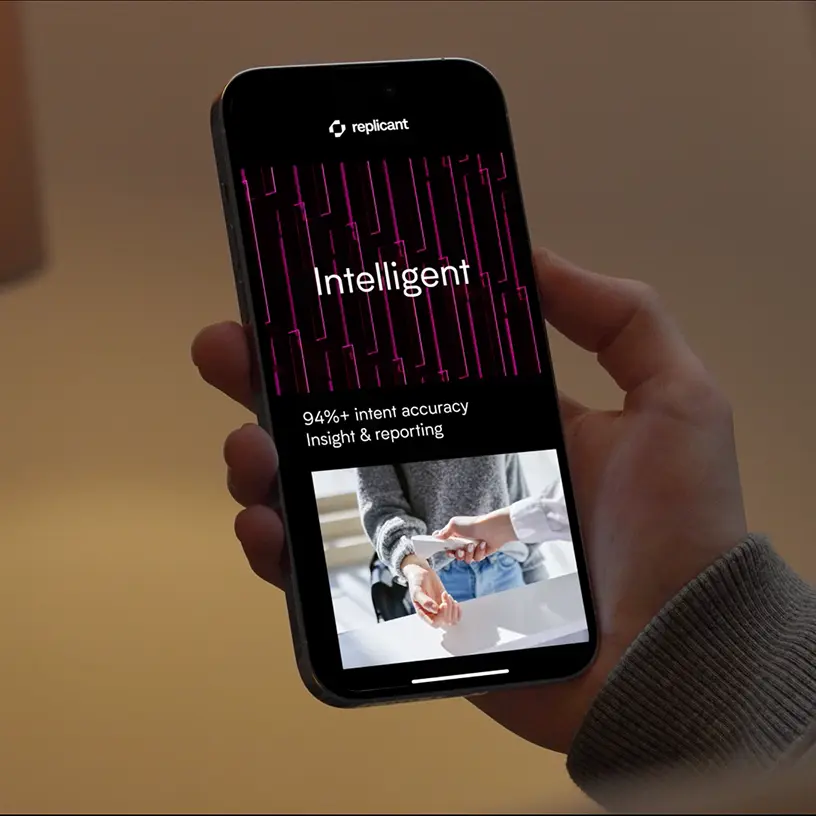
For our client Replicant, a leader in conversational AI, this was a critical part of their rebranding. Their “Thinking Machine™” interacts with enterprise customers, so the persona needed to balance machine intelligence with human empathy. We developed a brand voice that was sophisticated, trustworthy, and clear, aligning the AI with their team’s credibility.
Want to see our design process in action? Check out the Replicant case study to learn how we create intuitive AI experiences.
Read now
Designing for failure
A conversational system’s biggest test is how it handles failure. A brittle system that replies “I don’t understand,” creates a dead end. A resilient system uses a repair loop. It’s a pre-planned strategy to gracefully recover from an error.
Consider a user trying to book a flight:
| Before (The Dead End) |
|---|
| User: “I need a flight to Austin.” Bot: “Sorry, I can’t find any flights to Boston. Please try again.” |
The bot mishears, blames the user, and offers no path forward.
| After (The Repair Loop) |
|---|
| User: “I need a flight to Austin.” Bot: “I think you said Boston, is that correct? If not, could you please spell the city for me? You can also say ‘talk to an agent’ at any time.” |
This is different. The bot:
- Acknowledges uncertainty (“I think you said…”).
- Offers a simple fix (“Could you please spell…”).
- Provides an escape hatch (“talk to an agent”).
This approach transforms failure into a collaborative, trust-building exercise. By designing for error, we ensure the user never feels trapped, and only has a positive experience.
Common pitfalls

Improving user interaction with conversation design is often about what you avoid. Even advanced AI can fail if it falls into these design traps.
Trapping your users
| The Problem | The Result | The Fix |
|---|---|---|
| The bot is designed only for the happy path. It expects a specific input (order number) and has no plan for when the user provides something else (“I don’t have it”). | The bot endlessly repeats an error message: “Please provide a valid order number.” The user is trapped. This guarantees a user will abandon the conversation and never trust your AI again. | Every state in your flow must have an escape hatch. Always provide an alternative path, such as “I don’t have it,” “Skip this,” or “Talk to a human.” |
Catastrophic tone mismatch
| The Problem | The Result | The Fix |
|---|---|---|
| The AI’s pre-programmed tone is inappropriate for the user’s emotional state. | Imagine a user reporting a stolen credit card – a high-stress situation – is met with cheerful persona: “Oh no! Let’s get that sorted out for you! “ The interaction feels insulting and unempathetic. | Use sentiment analysis to detect the user’s emotional state. For high-stakes, negative scenarios like fraud or medical inquiries, the AI must switch its tone to be clinical, direct, and reassuring, stripping away all casual brand elements. |
Trying too hard to be human
| The Problem | The Result | The Fix |
|---|---|---|
| The bot’s attempt to fake human emotion comes across as disingenuous or creepy. | Users dislike when a machine pretends to have feelings it does not. Over-the-top fake empathy like, “I understand this must be a very trying time for you,” in response to a password reset feels manipulative. | Aim for competence, not consciousness. The goal of conversation design best practices is to create a bot that is helpful, clear, and efficient. Users will forgive a bot for being a machine, but not for being a bad liar. |
Experiencing these issues? A UX audit can identify friction points in your conversation flows and provide a roadmap for improvement.
Maximize your website's potentialThe modern toolset
Teams often try to design a dynamic conversation in a static tool.
Figma, while unparalleled for visual interfaces, is inadequate for architecting conversational logic. Mapping every conversational branch, user input, and error state in a static tool results in an unreadable spaghetti diagram. It cannot handle variables, remember context, or test how the flow feels in a real interaction. It is the wrong tool for the job.
The industry standard has shifted to logic-based prototyping platforms like Voiceflow. These tools are built specifically for conversational design. They allow designers to:
- Visually map complex logic with nodes and variables.
- Test the conversation flow interactively to find dead ends.
- Simulate API calls and test how the bot responds to real data.
- Provide developers with an executable blueprint, not just a flat image.
At Fireart, we use a hybrid approach. We use Figma to perfect the visual UI elements – chat bubbles, suggestion chips, and brand typography. We use tools like Voiceflow to build and test the underlying logic. This ensures that when we deliver our end-to-end product design services, the final product is beautiful and structurally sound.
Conclusion
Conversational design is a critical business strategy. The quality of the conversation directly impacts your bottom line.
By applying conversation design best practices – reducing cognitive load, building a cohesive persona, and designing repair loops – you create intuitive, efficient, and helpful interactions. By avoiding the tone mismatch and the loop of death, you transform your AI into a tool that boosts engagement and trust.
In the era of AI, the user interface is how your product speaks.
Ready to create conversational interfaces that connect with users? Fireart’s experts can help you design, test, and deploy AI experiences that strengthen your brand and solve user problems.
Contact us todayFAQ: Common questions about conversational design
How do you measure the ROI of investing in conversational design?
We measure success by tracking the Containment Rate (queries the AI resolves without human help) in combination with CSAT (Customer Satisfaction). High containment saves operational costs, while high CSAT proves the conversational UX is solving user problems, not just frustrating them.
How do I know if my current chatbot needs a UX redesign?
Review your chat logs for the loop of death. If analytics show high abandonment rates, frequent requests to “talk to a human,” or the bot constantly repeating “I don’t understand,” your flow is broken. A UX audit can identify these exact friction points.
How do you prototype a conversation before committing to expensive development?
We use logic-based prototyping platforms like Voiceflow and techniques like Wizard of Oz testing. This allows us to validate the conversational design principles, test edge cases, and ensure the dialogue feels natural with real users before writing any code.
With modern LLMs, how do you prevent the AI from going off-brand or hallucinating?
We implement Retrieval-Augmented Generation (RAG) to ensure the AI only pulls answers from your approved company data. We also build guardrails to maintain your defined persona, ensuring the agent remains a reliable extension of your brand.
Does Fireart provide the UX strategy or the actual technical development?
Both. We offer an end-to-end solution. We start with the conversational design – mapping the flows, defining the persona, and crafting the UX copy – and then our engineering team handles the prompt architecture, API integrations, and deployment of the chatbot or AI agent into your ecosystem.



 Kotlin
  C++
C++  C#
C#  Ruby on Rails
  Java
Java  Firebase
  Python
  Vue.js
  HTML5
HTML5  CSS3
CSS3  Azure
Azure