

Growing tech companies hit a capacity wall. You have a roadmap to execute, and internal engineers are drowning in backlog maintenance. Bringing in a dedicated web development team scales delivery and controls your HR overhead.
The outsourcing market is crowded. The gap between a sales pitch and engineering capability is wide. The wrong partner burns budget and creates architectural debt that takes years to unravel.
To understand how to hire web developers, analyze the total cost of ownership.
This guide breaks down the economics of software engineering in 2026. We look at market pricing, compare engagement models, and share the technical vetting probes engineering leaders use to find development partners.
Article highlights
- Global developer rates are stabilizing in 2026. The cost of software lies in the total cost of ownership.
- Choosing between fixed-price, time and materials, or a dedicated team dictates who absorbs project risk and scope creep.
- Vendor vetting requires demanding visibility into CI/CD pipelines, pull requests, and staging environments.
- Clear intellectual property (IP) assignment clauses avoid vendor lock-in and retain control of your source code.
Turn your roadmap into working software
Check our web development servicesThe cost of web development in 2026
When evaluating web development pricing, calculate the total cost of ownership (TCO).
In enterprise engineering, the build cost is 40% to 60% of the three-year TCO. A vendor who skips documentation, ignores architecture, and fails to set up automated testing costs you in rework and technical debt.
When estimating your software development cost, look at market benchmarks that factor in project management, quality assurance, and DevOps overhead.
Global hourly rates for senior developers
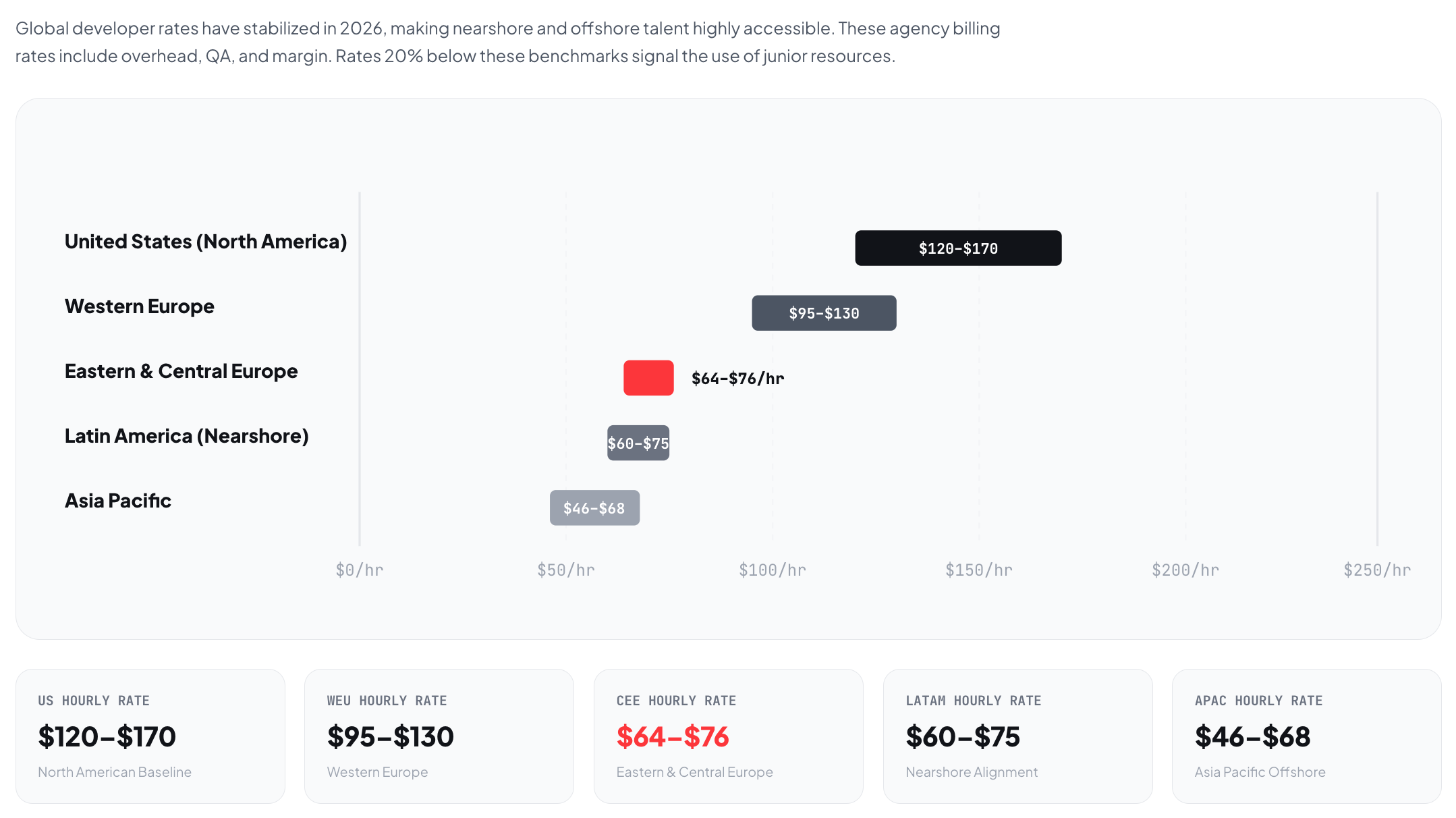
Geographic arbitrage plays a role in web development cost. According to the 2026 Accelerance Global Outsourcing Rates guide, offshore and nearshore rates have cooled, making global talent accessible.
Here are the 2026 billing benchmarks for senior developers across regions. These are agency billing rates, which include overhead, QA, and margin.
- United States (North America): $120 – $170 / hr
- Western Europe: $95 – $130 / hr
- Eastern & Central Europe: $64 – $76 / hr
- Latin America: $60 – $75 / hr
- Asia Pacific: $46 – $68 / hr
A rate 20% or more below these averages is a red flag. It indicates they plan to deploy juniors or underestimate the complexity of your build.
Project budget classifications
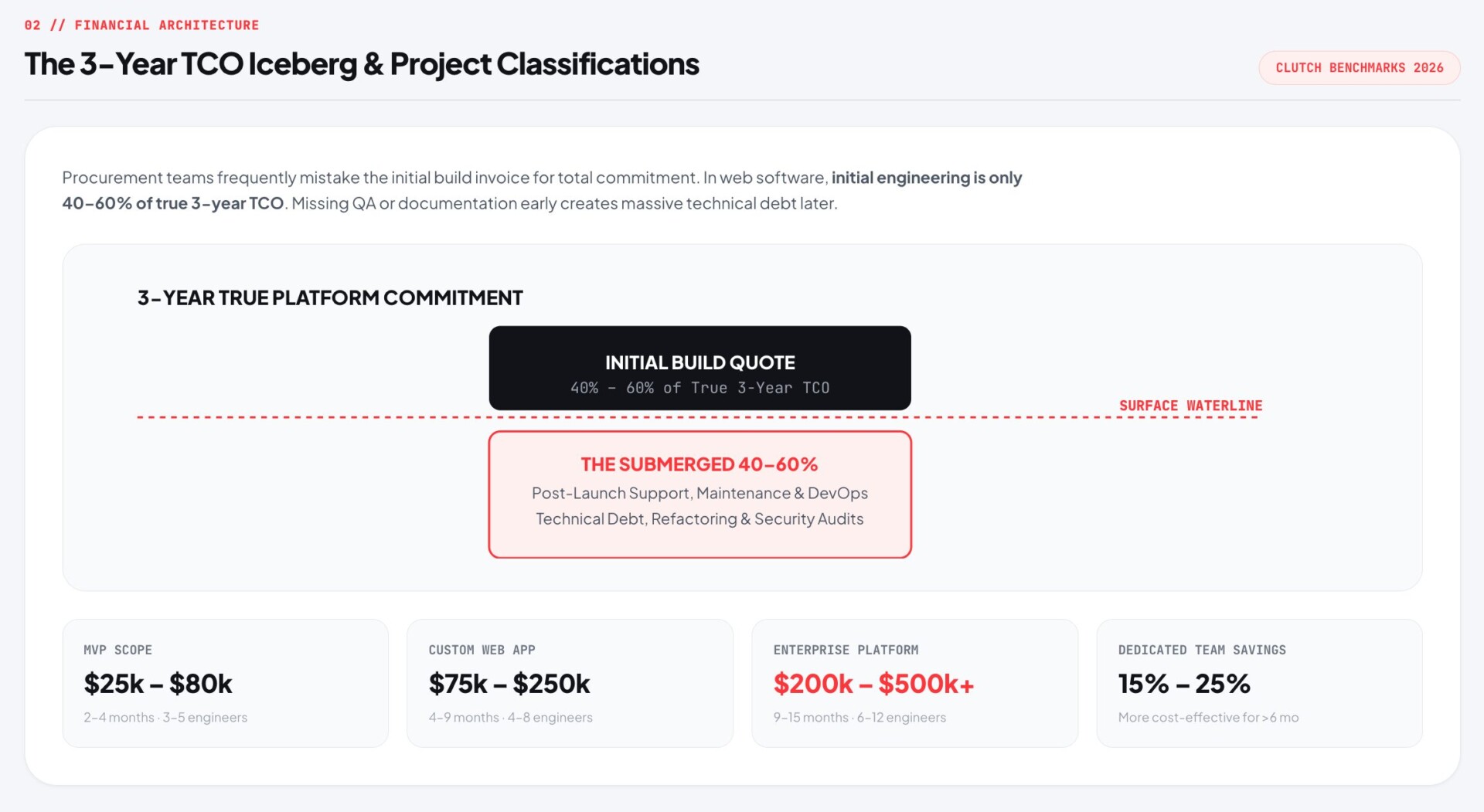
Based on 2026 market data from platforms like Clutch and industry benchmarks, capital allocations for web builds fall into three tiers.
- Minimum Viable Product (MVP): $25,000 – $80,000
Designed for market validation. This covers a feature set, UI design, authentication, and integrations. It takes a team of 3 to 5 people 2 to 4 months to deliver. - Custom web application: $75,000 – $250,000
A platform meant for scaling. This budget accommodates third-party API integrations, backend architecture, user roles, and a QA cycle. Expect a timeline of 4 to 9 months with a team of 4 to 8 specialists. - Enterprise platform: $200,000 – $500,000+
Systems requiring multi-tenant architecture, role-based access controls (RBAC), compliance mandates (SOC2, HIPAA), and distributed microservices. These projects demand continuous DevOps orchestration and span 9 to 15 months with an engineering pod.
Choosing your engagement model
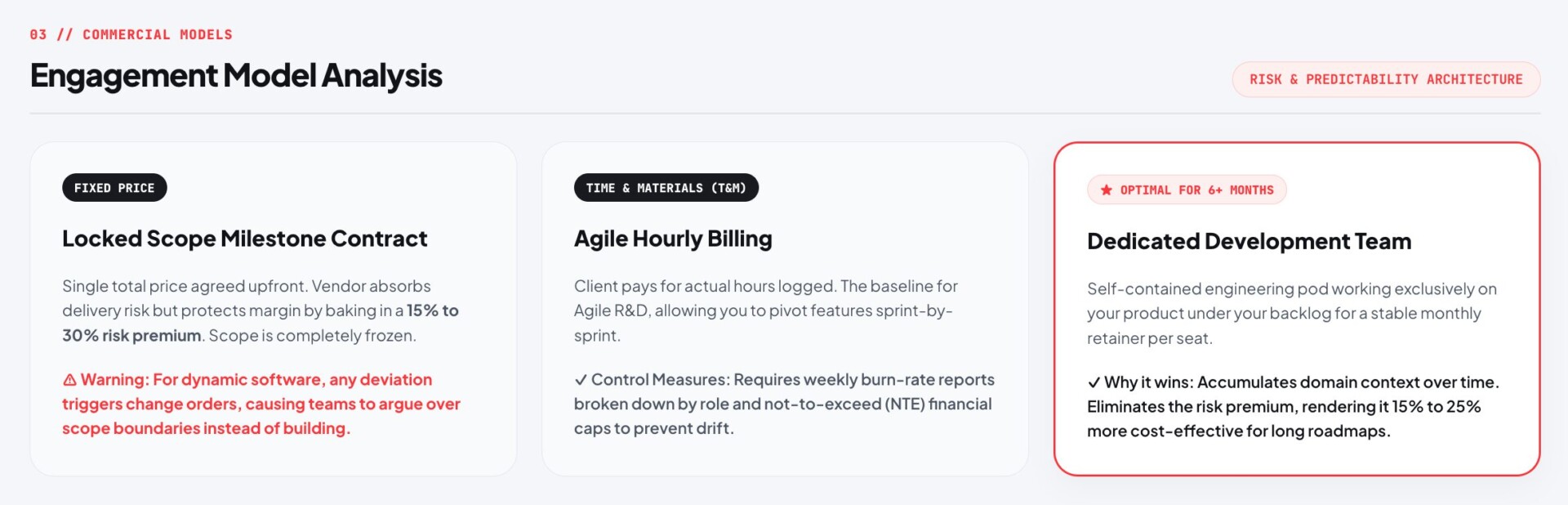
The contract structure of web development pricing models dictates your project’s agility. Selecting the wrong framework creates friction between your procurement department and the engineering team. Your choice determines who absorbs the risk when project requirements change.
Fixed-price contracts
In a fixed-price arrangement, you agree on a total cost and a delivery date based on a detailed scope. The vendor absorbs the financial risk if the project runs over schedule.
This predictability comes at a cost. Agencies bake in a 15% to 30% risk premium on top of the estimate. If your requirements are locked down, this model works. For dynamic software, any deviation from the spec triggers a change order. Your team spends time arguing over scope boundaries.
Time and materials (T&M)
Time and materials flips the risk equation. You reimburse the vendor for the engineering hours logged and materials used. This is the baseline model for Agile development, allowing you to pivot features, shift priorities, and react to market feedback sprint by sprint.
It is a fit for evolving products or exploratory R&D phases. The danger is budget drift.
The dedicated web development team
When your product roadmap stretches beyond six months, transitioning to a dedicated web development team is the optimal operational move. You pay a stable monthly retainer per engineering seat.
The vendor handles recruitment, benefits, equipment, and retention. Your internal product owners maintain technical leadership and control over sprint priorities.
This model provisions a self-contained engineering pod that acts as an extension of your in-house team. Because the same engineers own the codebase for a year or more, they accumulate domain context. For engagements lasting over six months, a dedicated IT staff augmentation setup is 15% to 25% more cost-effective than a fixed-price contract.
Expand your team with dedicated engineers
Add developersTechnical vetting: How to hire web developers safely
To learn how to hire web developers, look at engineering hygiene.
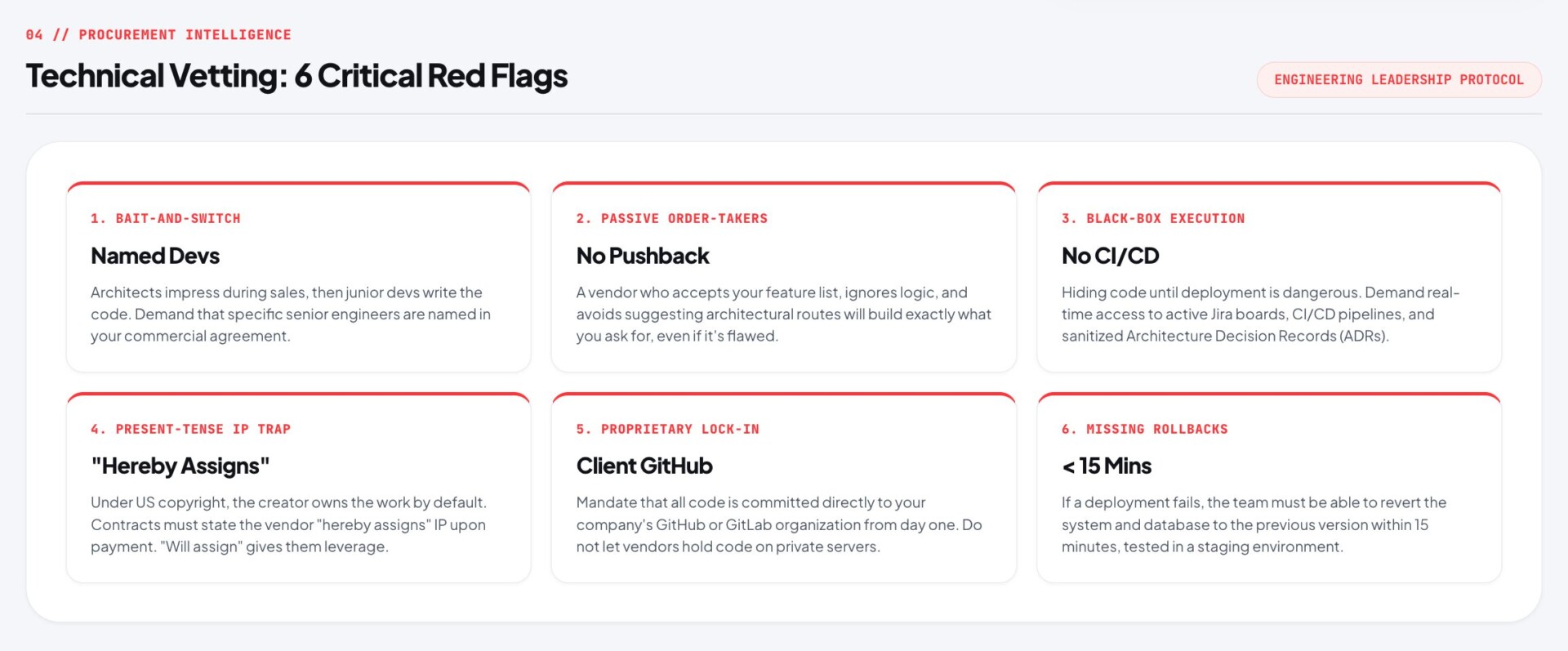
Experienced technical leaders dig directly into operational realities. Use these vetting probes during your procurement process to identify engineering partners.
Watch for bait-and-switch
You hop on a discovery call and meet a solutions architect. You sign the master services agreement, and that architect is rotated to the next sales pitch. The coding is handed off to junior developers.
To know how to choose a web development company that plays fair, demand that specific senior engineers are named in your commercial agreement.
Watch out for the no questions asked approach. A vendor who accepts your feature list, ignores logic, and avoids suggesting architectural routes is a passive order-taker. A true website design and development team is empowered to challenge ideas before they become code.
Demand CI/CD and architectural transparency
Demand real-time access to active Jira boards and continuous integration (CI/CD) pipelines. Black-box execution hides architectural defects and integration gaps until the deployment deadline.
Ask the vendor to walk you through a production outage or provide a sanitized Architecture Decision Record (ADR) from a past project. A mature team will show you how they mapped out a database migration or handled a server load.
Lock down your IP and source code
By default, under U.S. copyright law, the creator owns the work unless a written agreement states otherwise.
Review the contract language. It must state that the vendor hereby assigns all intellectual property rights to you upon payment. Future-tense phrasing like will assign gives vendors leverage during scope disputes.
Mandate that all code is committed directly to your company’s GitHub or GitLab organization from day one. This prevents vendor lock-in.
What to expect from a development lifecycle
Once you hire a web development team, the focus shifts from procurement to execution. A professional agency anchors the project around verifiable artifacts.
Here is what an Agile delivery process looks like.
Discovery that mitigates risk
Skipping technical discovery is the primary cause of scope creep.
A team invests two to four weeks to de-risk the project. This phase bridges the gap between web design and backend reality. A discovery sprint outputs a functional code artifact, API contracts, entity-relationship diagrams (ERDs), and a milestone roadmap. Mapping out integration complexities before writing the application prevents building on assumptions.
Continuous QA and performance gating
QA operates continuously throughout every sprint.
Your team should enforce programmatic test suites that run automatically on every pull request. They should enforce performance gates. For example, builds should fail if they regress beyond Core Web Vitals thresholds—such as keeping the Largest Contentful Paint (LCP) under 2.5 seconds or Cumulative Layout Shift (CLS) under 0.1 at the 75th percentile.
Demand tested rollback parameters. If a deployment fails, your team should revert the system to its previous version within 15 minutes, including database rollbacks. The rollback plan must be tested in a staging environment.
Why partner with Fireart Studio?
When you hire a web development team with Fireart, you bring on an engineering partner that integrates into your workflows, and commits to transparency.
We ground every engagement in technical discovery. Before we write code, we define the scope, map the API contracts, and establish the CI/CD pipelines. Our QA is an automated, continuous cycle designed to enforce performance thresholds and ensure scalability.
Whether you need a squad for an end-to-end build or a dedicated web development team to augment your engineers, we structure our partnerships around accountability. You own the code, you retain the IP, and you maintain visibility into the sprint backlog. We build software that performs in the real world.
Start a conversation about your software requirements
Speak to an engineering leadConclusion
Making the choice to hire a web development team demands an evaluation of the total cost of ownership, technical hygiene, and architectural alignment.
Start by defining your product roadmap. If you are validating a prototype, a time and materials contract makes sense. For evolving products, a dedicated web development team is the efficient choice. You gain the predictability of a monthly budget and the advantage of engineers who retain institutional knowledge about your codebase.
Choose an engineering partner based on their delivery capability, transparency, and willingness to protect your intellectual property.
FAQ: Hiring a web development team
What drives the web development cost?
The web development outsourcing cost is dictated by architectural complexity, third-party integrations, and compliance requirements. An MVP might cost between $25,000 and $80,000. Enterprise SaaS platforms requiring multi-tenant architecture and continuous DevOps range from $200,000 to $500,000+.
How do I hire web developers for a project?
To learn how to hire web developers for a product roadmap, opt for a dedicated capacity model. This ensures the same engineers remain on your product for months or years. They retain institutional knowledge and prevent architectural rewrites.
What is a dedicated web development team?
It is a self-contained engineering pod—including frontend and backend developers, QA engineers, and a tech lead—provided by a vendor dedicated to your product for a monthly fee. You control the sprint backlog and roadmap. The vendor handles recruitment, benefits, equipment, and developer retention.
Which of the web development pricing models should I choose?
If you have a three-month project with zero flexibility, use fixed-price. If you are experimenting with an MVP, use time and materials (T&M) and demand weekly burn-rate reporting. For development over 6 months, use a dedicated team to get budget predictability and scope flexibility.
How do I choose a web development company?
To learn how to choose a web development company, look at their infrastructure and legal contracts. Demand a written agreement stating they hereby assign all intellectual property (IP) to you upon payment. Require the team to commit code directly to your version control repositories (like your company’s GitHub).






 Kotlin
  C++
C++  C#
C#  Ruby on Rails
  Java
Java  Firebase
  Python
  Vue.js
  HTML5
HTML5  CSS3
CSS3  Azure
Azure