

Generating a high-fidelity interface now takes three seconds. Yet, shipping a product users trust is harder than ever.
The convergence of AI and UI design has commoditized execution. Machines synthesize data and assemble responsive layouts instantly. The competitive advantage is no longer the speed of rendering a screen. The moat is architectural constraint, strategic empathy, and curatorial judgment.
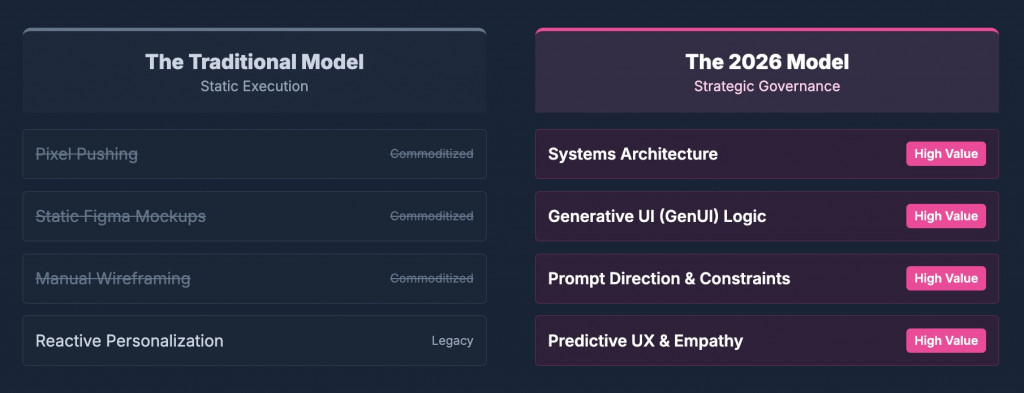
As enterprises move to autonomous agents, the design mandate has inverted. You are engineering the systemic rules and psychological guardrails that govern how AI builds the interface around the user.
Article highlights
- The shift to dynamic generation. Static SaaS dashboards are being replaced by generative ui design, where the interface is assembled at runtime to match the user’s intent.
- The bot-bland aesthetic. Algorithmic execution often results in design slop – homogenous, sterile interfaces that erode brand trust.
- The changing value of skill sets. Wireframing and pixel-pushing are depreciating; the highest value now lies in systems architecture and soul-injection to overcome algorithmic limitations.
- The curation burden. AI imposes massive cognitive loads on quality assurance. Designers must audit AI UX hallucinations to prevent impossible user flows from reaching production.
Are you building a product with embedded AI? Fireart designs the systemic guardrails and user experiences that make intelligent features feel intuitive.
Explore our Product Design ServicesThe end of the static screen
The traditional model of Software-as-a-Service – where users navigate rigid hierarchies of pre-designed dashboards – is facing obsolescence. Modern interfaces adapt and generate themselves.
The future of UX design with AI abandons the concept of the static screen.
Generative UI (GenUI)
Dynamic interfaces AI are now the baseline expectation. In a Generative UI paradigm, the user interface is rendered programmatically on the fly.
If a user asks an AI-enabled analytics platform to “compare Q3 revenue by region,” the system does not direct them to a pre-existing reporting page. Instead, it generates a bespoke, interactive data table and charting component specifically for that query. Once the task is completed, that micro-interface dissolves.
If a user asks an analytics platform to compare Q3 revenue by region, the system does not direct them to a pre-existing page, but generates a bespoke data table and chart specifically for that query. Once the task is completed, that micro-interface dissolves.
| Feature | Static SaaS | Generative UI (GenUI) |
|---|---|---|
| Interface | Pre-designed, rigid dashboards | Assembled at runtime based on intent |
| User Flow | Linear, predicted paths | Adaptive, non-linear sessions |
| Deliverable | Definitive screen layouts | Systems of constraints & design tokens |
For the product team, this fundamentally alters the deliverable. Designers no longer create a definitive layout. They engineer the systems of strict design tokens, accessible color pairings, and component logic that act as guardrails.
Predictive UX
Predictive models now anticipate intent before an action is taken. This utilizes edge computing and real-time behavioral data to restructure navigation and auto-fill parameters.
While this reduces decision fatigue, it introduces the uncanny valley of UX. If a system anticipates a need too aggressively – such as pre-filling highly sensitive legal or medical forms based on background data – it shifts from feeling helpful to feeling invasive. The designer’s mandate is to embed transparency, ensuring users maintain agency and can easily override automated predictions.
Is your static SaaS holding back your AI initiatives? Transition to generative interfaces via systemic logic of the AI era.
Explore Application Reengineering ServicesThe reality of the AI workflow frictions
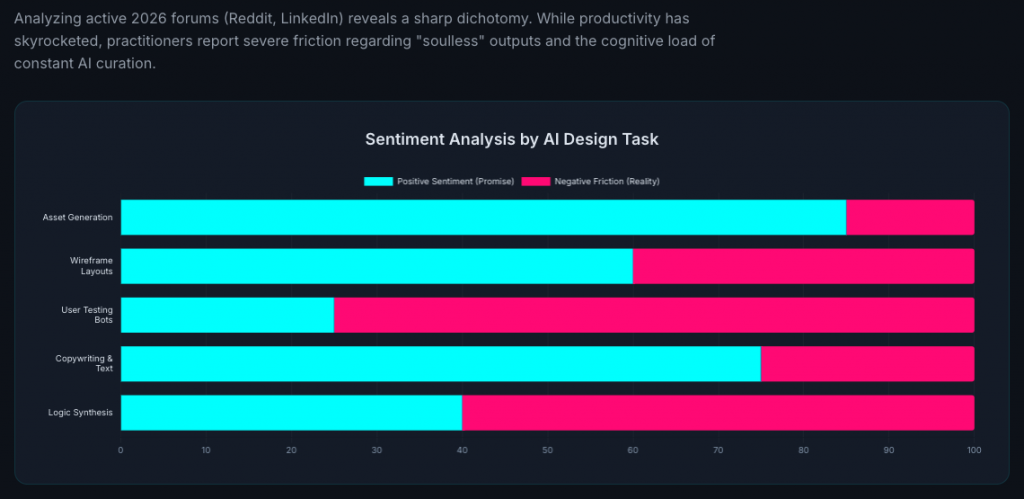
The narrative sold by software vendors suggests that AI will automate the entire product lifecycle from a single prompt. The reality for teams operating these tools is a mix of productivity gains and operational friction. Here’s the Designweek’s breakdown of designers assessment of AI usefulness for different types of tasks:
| Task Type | Sentiment | Key Findings |
| Ideation & Brainstorming | Very Positive | 72% of designers use AI to break “blank page syndrome”. |
| Routine & Repetitive Tasks | Highly Positive | 68% use AI to speed up tasks like resizing and basic layouts. |
| UX/UI Design (Drafting) | Positive/Cautious | 54% use it for imagery/video generation. 80% of designers believe AI is better than humans at replicating standard UI patterns. |
| Copywriting | Positive | 79% of designers use AI for creating content or UI copy. |
| Final Production/Finishing | Skeptical | Only 6% of designers prioritize AI for final production. |
AI design workflow adaptation requires acknowledging that AI does not eliminate work; it shifts the burden from creation to curation.
The promise: velocity
The acceleration of early-stage ideation is undeniable. Multimodal AI in design allows teams to engage in vibe coding – rapidly prototyping functional layouts using natural language. The integration of AI in research has automated the synthesis phase. Hundreds of hours of interview transcripts are now codified into insights instantly.
The friction: the bot-bland era
Despite the velocity, relying entirely on uncurated AI UI design tools in 2026 produces critical systemic failures.
The most prominent issue is the homogenization of digital products. AI models regress to the mean, prioritizing statistically safe layouts. The output is bot-bland – hyper-clean, perfectly aligned, but sterile interfaces. This homogeneity causes generative blindness; users instinctively ignore generic, automated aesthetics.
The danger of hallucinated logic
AI wireframe generators often lack comprehension of structural physics.
Those limitations of AI in UI design manifest as complex ghost components like a checkout flow that bypasses a payment gateway. Combating these hallucinations causes severe curation fatigue – the energy required to audit and fix these flawed outputs can exceed the effort of designing the interaction from scratch.
The skill value shift from creator to custodian
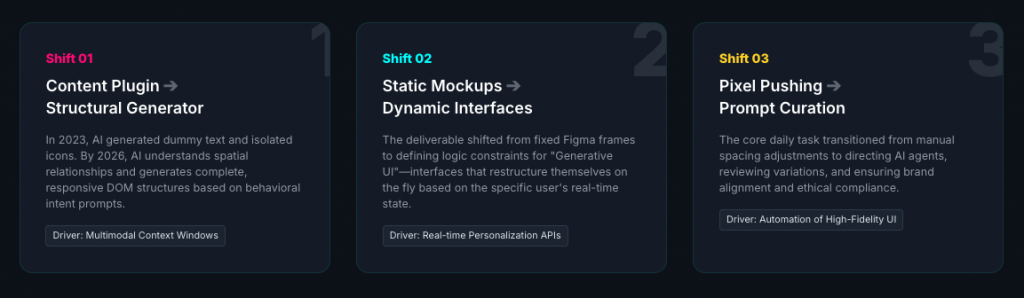
Artifact generation is a commodity. In the UX designer vs AI dynamic, the machine wins on raw execution. Value now lies in two high-leverage areas: architectural and psychological skills.
Systems architecture and prompt direction
Designers must structure component libraries that are modular enough for an AI agent to query and assemble. This requires mastering prompt direction and establishing technical constraints that prevent models from generating unmaintainable code or inaccessible color pairings.
| Old Skill | New Requirement |
| Drawing Buttons | Writing logical parameters for button deployment |
| Screen Mapping | Engineering systemic guardrails |
| Pixel Pushing | Auditing algorithmic logic and security |
Soul-injection and empathy
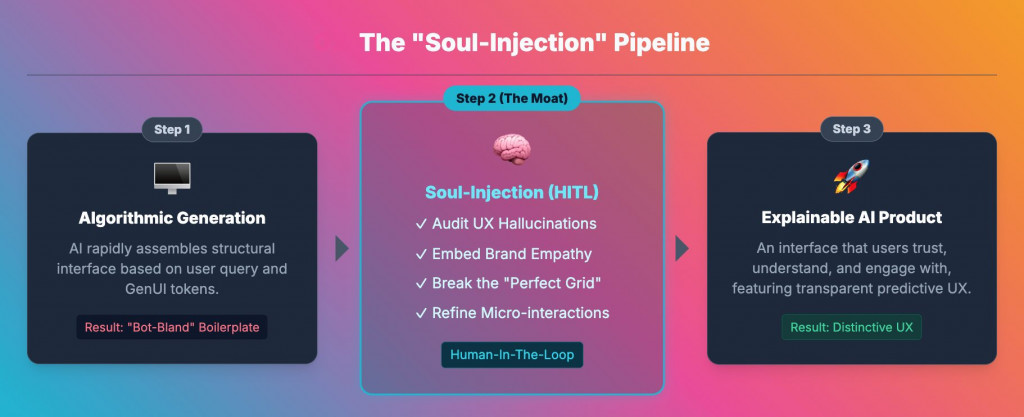
If AI creates the bot-bland boilerplate, humans provide the resonance. Industry insiders call this soul-injection. It is the manual process of refining typography and micro-interactions to ensure they align with a brand personality.
AI can simulate structure, but it cannot organically simulate human empathy. The ability to intentionally break the AI grid to create moments of delight and hospitality is the ultimate competitive moat.
Struggling with bot-bland AI outputs? Get vetted senior experts who know how to architect logic and inject brand empathy.
Explore Design Team AugmentationHow Fireart architects intelligent interfaces
Integrating LLMs into your product requires moving beyond Figma AI alternatives and simple chat plugins. It requires systems engineering.
At Fireart, when we develop products that rely on predictive UX or dynamic generation, we focus on the systemic architecture first.
Governing the AI experience
We mitigate the risk of AI UX hallucinations through architectural constraints. Our process builds the logic frameworks that dictate exactly how your in-app AI agents are permitted to construct interfaces.
Designing for trust with explainable AI (XAI)
We ensure that predictive features and automated workflows do not alienate your users. Using explainable AI (XAI) principles, we design interfaces that communicate why a prediction was made, providing visual citations and manual overrides.
Conclusion
Tactical execution and high-fidelity mockups are the new baseline. As digital environments shift to generative systems, the role of design moves to strategic governance.
The winners will set architectural constraints to win in tactical execution while avoiding AI design slop. Meanwhile, human talent will focus on injecting empathy and building trust with the last-mile enhancement of the designs and interfaces.
In the era of autonomous systems, your curatorial judgment becomes your competitive moat.
Want adaptive interfaces in your software? Fireart helps build AI products that earn trust and scale securely.
Contact us to discuss a roadmapExecutive FAQ
Will AI replace UI/UX designers?
The role is shifting from Creator to Director. AI handles the high-volume generation; humans establish the systemic rules and audit the logic.
What exactly is Generative UI (GenUI)?
It is a shift where interfaces are assembled programmatically at runtime, creating an ephemeral custom UI based on the user’s exact query.
What are the primary limitations of using AI for UI design?
The primary risks are bot-bland aesthetics and UX hallucinations – visually polished flows that lack back-end logic and erode trust.
How do you prevent "homogenous" or generic AI design?
Through soul-injection. Designers must manually apply micro-interactions and nuanced copywriting to ensure the interface resonates with the brand.
Do I need a different skill set for prompt engineering?
Yes. Modern UI design requires a skillset of prompt engineering for UI designers – understanding how to set logical and mathematical parameters for the AI by translating visual design systems into text-based constraints.
How does AI-accelerated development impact project cost?
It makes engineering hours efficient. When routine tasks are finished faster, you get a larger scope for your budget.




 Kotlin
  C++
C++  C#
C#  Ruby on Rails
  Java
Java  Firebase
  Python
  Vue.js
  HTML5
HTML5  CSS3
CSS3  Azure
Azure