

When Sparkbox asked eight of its developers to code the same contact form twice, the median build took 4.2 hours from scratch and 2 hours with IBM’s Carbon design system. The second number included the time they spent learning Carbon. That is the case for a design system in one test: the same screen, half the time.
The catch is that the saving only appears once the system exists, matches the code and gets used by more than one team. That is what you pay a design system agency for. Drawing a Figma library is the easy part. The hard parts are token architecture, components that engineers actually import, documentation people open and an owner who keeps it all alive after handover.
This guide compares ten design system agencies and consultancies for product and design leaders at software companies, enterprise teams with several products or brands, and founders who need their first system built during a redesign. We checked every agency against the same five criteria on November 8, 2026. The evidence is each agency’s own case studies, its Clutch profile where it has one and any pricing it publishes.
A disclosure before the list: Fireart Studio publishes this guide, and we are on it. Fireart sits at number one as a statement of fit for one buyer situation, a product company that wants a redesign and a design system built together by one team that can also write the front end. It is not a verdict on the other nine. For organization-wide governance, coded component libraries or AI-ready tooling, the cards point elsewhere. The methodology section after the list explains how the cards were built, and our UI/UX design services page shows how we run this kind of work.
| Quick answer: For a fast, tokenized foundation with visual testing, start with Rangle. For coded components ready for AI coding agents, Southleft. For migrating or documenting an enterprise system, Sparkbox. For governance across many teams, Big Medium or Directed Edges. For a redesign and a system built together at mid-range rates, Fireart Studio. |
Top 3 design system agencies at a glance
| Agency | Best for | Clutch rating | Starting budget |
|---|---|---|---|
| Fireart Studio | A product redesign and its design system built together, with front-end development in-house | 4.9 (40 reviews) | $10,000+ |
| Rangle | A tokenized foundation with a coded library, Storybook and visual testing in weeks | No Clutch profile | Not published (4 to 8 week builds and up) |
| Southleft | Coded component libraries and tooling that AI coding agents can use | 4.9 (9 reviews) | $10,000+ |
Ratings and minimum project sizes as listed on Clutch on November 8, 2026. Rangle’s engagement length is from its design systems page.
TL;DR
- Rangle shipped a tokenized design system foundation for Avinode in six weeks, with Storybook and Chromatic visual tests.
- Southleft builds React and web component libraries and publishes open-source MCP tools that connect Figma and Storybook to AI agents.
- Sparkbox has worked inside Adobe’s Spectrum team for years and led a six-month move of its documentation into one Storybook.
- Big Medium and Directed Edges focus on strategy, architecture and adoption rather than production.
- Clearleft fits UK and EU organizations that want to build the system with their own team.
- thoughtbot, Netguru and Superside cover audits, system plus app build, and brand systems on a subscription.
- Fireart Studio fits a product redesign where the system gets built during the work, at $50 to $99 an hour.
Which design system agency fits which situation?
Match the agency to the part of the system you cannot do yourself. If your designers can draw components but nobody can ship them in code, hire engineers. If you have a library that nobody uses, hire people who fix adoption. If you have neither, hire a team that can do both on a real product.
Our evaluation criteria
Each card rates the same five criteria as Full, Partial, Not disclosed or Not offered. There are no scores, because a 9 out of 10 hides which part is missing.
- Design system depth. Named client design systems with case studies on the agency’s own site, not a “Design systems” tile on a services page.
- Tokens and Figma foundations. Token architecture, Figma variables and libraries, and theming for brands, modes and platforms.
- Coded components and tooling. Components shipped in code (React, web components or another framework), Storybook, token pipelines and tooling for AI agents.
- Governance and adoption. Ownership, contribution models, training, handover and how adoption gets measured.
- Proof and transparency. Published numbers, review counts and rates.
Who this guide is for
- Heads of product and design at software companies whose UI has drifted across teams.
- Enterprise teams with several products or brands that need one system to serve all of them.
- Founders and product leads who need a first design system built during a redesign.
- Engineering leads who want coded components their teams, and their AI coding tools, can use.
If you need a single brand style guide or a logo refresh, you need a branding studio, not a design system consultancy. Only one agency here, Superside, works mainly at the brand level, and its card says so.
The 10 design system agencies covered
| # | Agency | Best for | Headquarters | Ships coded components |
|---|---|---|---|---|
| 1 | Fireart Studio | Redesign and design system built together | Warsaw, Poland | In-house front-end team; no public coded library |
| 2 | Rangle | Fast tokenized foundation with pipelines and visual tests | Toronto, Canada | Yes |
| 3 | Southleft | Coded components ready for AI coding agents | New Orleans, US | Yes |
| 4 | Sparkbox | Migrating and documenting an existing enterprise system | Ohio, US | Yes |
| 5 | Big Medium | Strategy and coaching for multi-brand enterprises | Not stated | In its 2017 cases; current stack not named |
| 6 | Directed Edges | A senior architect for an in-house system team | Virginia, US | No |
| 7 | Clearleft | UK and EU organizations building skills in-house | Brighton, UK | Sometimes; often the client’s developers build |
| 8 | thoughtbot | Audit and system for web product teams | New York, US (remote team) | CSS architecture in published work |
| 9 | Netguru | System plus the whole app built by a large team | Poznań, Poland | Through app delivery |
| 10 | Superside | Brand systems for marketing teams on a subscription | Remote | No |
After Fireart, the order follows buyer situations, not quality: build specialists first, then strategy and governance, then regional and generalist options, then a brand-level option.
1. Fireart Studio
Specializes in: Product design and front-end development for companies that need a design system built while their product is being redesigned or launched.
Headquarters: Warsaw, Poland
Founded: 2013
Team size: 60+ (Clutch lists 50 to 249)
Clutch rating: 4.9 from 40 reviews
Evaluated on the basis of:
- Design system depth: Partial. One public case where the system is the core deliverable: CFI, a multi-asset trading broker, where we built a foundational design system for the whole product suite. On Clutch, Revionics, a retail technology company, describes our embedded design team creating a full design system. Smaller systems sit inside redesign cases such as the Parents app.
- Tokens and Figma foundations: Partial. The CFI system is a library of reusable components, UI patterns and guidelines shared with CFI’s designers and developers. We have not published a token architecture or a multi-brand theming case.
- Coded components and tooling: Partial. Our engineers build in React, Vue, Angular and React Native, so the same team can take a system into code. We have not published a coded component library, a Storybook site or a token pipeline.
- Governance and adoption: Partial. CFI’s global design teams took the library over and used it to design CFI Prime, Trading Transparency+ and CFI Rewards. We do not offer a separate governance or contribution-model service.
- Proof and transparency: Partial. The CFI system carried a 50+ page website and a 250+ screen app redesign. We report a 25% increase in user engagement and retention (vendor-reported). Rates and minimums are public on Clutch.
Differentiator: The system gets built during a real redesign, so its first test is 50+ pages and 250+ screens rather than a sample page, and the same studio can design the product and build its front end.
Proof of execution: CFI: website redesign across 50+ pages, a 250+ screen mobile app redesign and a library of reusable components and UI patterns that CFI’s teams reused for three later products. Design lead: Dima Lytvynenko. Revionics review on Clutch by Matthew Law, Director of UI/UX: an ongoing staff augmentation engagement since September 2021 ($200,000 to $999,999), which Clutch’s project summary describes as creating “a full design system” and contributing to three platforms.
Pricing: $50 to $99 per hour, projects from $10,000 (Clutch).
Potential limitation: No public case with design tokens in code, a coded component library or a documentation site, and no dedicated design system services page yet. If your system has to serve many product teams from day one, Directed Edges and Big Medium have far more published system work, and Southleft or Sparkbox have more coded component proof.
My take: Fireart fits a product company with one to three products that wants a redesign and a design system built together, by a team that can also write the front end, at Central European rates. For an organization-wide system with formal governance across dozens of teams, start with a specialist from this list.
2. Rangle
Specializes in: Design system builds with token pipelines, coded component libraries, visual testing and governance, delivered by an embedded team.
Headquarters: Toronto, Canada, with an office in Amsterdam
Founded: 2013
Team size: Not stated on its site (Built In lists 107)
Clutch rating: No Clutch profile found
Evaluated on the basis of:
- Design system depth: Full. Published systems for Avinode (business aviation), Sanofi (Elements), an unnamed European travel company and Varis, an Office Depot startup.
- Tokens and Figma foundations: Full. Centralized tokens with semantic layers for Avinode, a Tokens Studio to GitHub to TypeScript pipeline for Sanofi, and a custom Figma plugin that syncs tokens and opens pull requests for the travel client.
- Coded components and tooling: Full. Avinode’s library sits in a monorepo with Storybook and Chromatic visual regression tests. The travel company got 35+ components on shadcn/ui. Rangle also maintains Radius, a design system meta-framework.
- Governance and adoption: Full. Training and governance structures so Avinode’s core teams maintain the system, and central governance for Sanofi.
- Proof and transparency: Partial. Timelines are public (six weeks for Avinode, four months for the travel company, under ten months for Sanofi), and Rangle reports production build times cut by over 90% for the travel client (vendor-reported). No review platform profile and no published rates.
Differentiator: Speed with engineering depth: a tokenized, tested foundation in weeks, not a Figma file that waits for a separate build team.
Proof of execution: Avinode: a design system foundation “delivered in 6 weeks”, including two weeks of discovery, with design tokens, a component library, Storybook, Chromatic and a governance model for teams working in Java and .NET.
Pricing: Not published. Rangle says engagements run from focused 4 to 8 week builds to longer partnerships, and that comprehensive systems take three to six months.
Potential limitation: No Clutch or similar review profile, so you cannot read independent client reviews before the first call, and no published rates to compare.
My take: Rangle fits an enterprise or scale-up that wants a working, tokenized foundation fast and has engineers ready to adopt it. If you want independent reviews and published rates before the first call, thoughtbot or Netguru show both.
3. Southleft
Specializes in: Design systems engineering: coded component libraries, token-first architecture and open-source tooling that connects Figma and Storybook to AI coding agents.
Headquarters: New Orleans, Louisiana, US
Founded: 2012
Team size: Clutch lists 10 to 49; the site describes a small senior team
Clutch rating: 4.9 from 9 reviews
Evaluated on the basis of:
- Design system depth: Full. PetSmart’s “Sparky” system, built with Big Medium, and CampusIQ (2026), plus Southleft’s own Altitude system.
- Tokens and Figma foundations: Full. CampusIQ is a token-first system, and Altitude uses Style Dictionary tokens.
- Coded components and tooling: Full. CampusIQ unified three component libraries into 50+ React components (React 19, TypeScript, Tailwind CSS v4 on shadcn/ui) with Storybook. Southleft publishes open-source tools including Figma Console MCP and Story UI, which connects Storybook to AI agents over MCP.
- Governance and adoption: Partial. The PetSmart work included governance for in-house adoption. Strategy and governance often come from partners: Big Medium on PetSmart, and Baseline Design under a 2026 partnership.
- Proof and transparency: Partial. Clutch reviews exist but only nine. CampusIQ reports WCAG 2.1 AA for every component (vendor-reported). Hourly rate not disclosed.
Differentiator: The most published work on making a design system usable by AI coding agents, with tools any team can try before hiring.
Proof of execution: CampusIQ: three separate component libraries replaced by one library of 50+ React components with Storybook documentation, for a company that, per the case study, scaled from 5 to 20 employees.
Pricing: Projects from $10,000 (Clutch); hourly rate not disclosed.
Potential limitation: Founder TJ Pitre, who led much of the AI tooling, joined Figma in June 2026 and Southleft named a new CEO, Nicole Hampton. The company says it stays independent, with Pitre as chairman, but ask who will lead your project. One Clutch reviewer noted two tasks that ran well over estimated hours.
My take: Southleft fits a team that already has design leadership, in-house or through another agency, and wants senior engineers to turn it into coded components and AI-ready tooling. If you need research, visual design and the system from one team, look at Rangle or Fireart.
4. Sparkbox
Specializes in: Embedded design system work for enterprises: component migrations, documentation, governance and long-term maintenance.
Headquarters: Ohio, US (Clutch lists Bellbrook; other directories list Dayton)
Founded: 2009
Team size: 22 on its team page (Clutch lists 10 to 49)
Clutch rating: 4.8 from 2 reviews
Evaluated on the basis of:
- Design system depth: Full. Adobe’s Spectrum, the National Council of State Boards of Nursing (NCSBN) pattern library since 2014, and Crown since 2018.
- Tokens and Figma foundations: Partial. NCSBN’s later microsites needed only theme token updates, and Crown’s work included a Sketch to Figma migration. No published token architecture beyond that.
- Coded components and tooling: Full. For Adobe, Sparkbox worked with the Spectrum CSS and web components teams, and its NCSBN library runs in code (first Drizzle, then 11ty). It used AI to draft component analysis for migration planning.
- Governance and adoption: Full. Governance guidelines for Crown, and an onboarding, sprint and offboarding model that ends in knowledge transfer.
- Proof and transparency: Partial. Sparkbox reports moving about 75% of Spectrum CSS components to Spectrum 2 and saving about a week of development per NCSBN microsite (vendor-reported). Only two Clutch reviews.
Differentiator: Years inside existing enterprise systems, plus its own published research on design system ROI, including the Carbon test cited at the top of this guide.
Proof of execution: Adobe Spectrum: a small engagement that became a multi-year relationship, in which Sparkbox migrated about three quarters of the Spectrum CSS components to the Spectrum 2 design language and led a six-month effort to unify all documentation into a single Storybook.
Pricing: $150 to $199 per hour, projects from $50,000 (Clutch).
Potential limitation: Two Clutch reviews, one from 2017, and a $50,000 minimum. No published AI agent or MCP tooling, so for AI-ready components Southleft has more to show.
My take: Sparkbox fits an enterprise that already has a system and needs an experienced team to migrate, document and govern it. For a first system at a startup budget, it is likely more than you need.
5. Big Medium
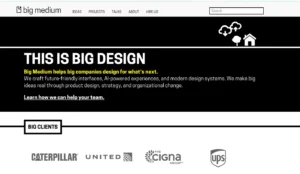
Specializes in: Design system strategy, architecture and coaching for large multi-brand and multi-product organizations, with a newer focus on AI-driven interfaces.
Headquarters: Not stated (principal Josh Clark is based in Asheville, North Carolina)
Founded: Not stated
Team size: Not stated; the site says it can scale teams quickly
Clutch rating: No Clutch profile found
Evaluated on the basis of:
- Design system depth: Partial. Two detailed case studies, ExxonMobil’s “Unity” and Dotdash, both from 2017. Newer clients such as PetSmart and Caterpillar appear in a partner’s case study or on its client list, not in Big Medium case studies.
- Tokens and Figma foundations: Partial. Unity included color themes for ExxonMobil sub-brands. No recent token work published.
- Coded components and tooling: Partial. Unity shipped nearly 100 interface components with a CSS framework and a reference site with copy-paste code. The current tech stack is not named.
- Governance and adoption: Full. Big Medium builds systems through the roadmap projects a company needs anyway, pairs designers with developers and says it aims “never to make clients dependent on us”.
- Proof and transparency: Partial. Dotdash’s new verticals “more than doubled engagement in every metric” (vendor-reported, 2017). No review profile or pricing.
Differentiator: Josh Clark and a team that treats adoption as a people problem first, and builds the system through real product work instead of a separate track.
Proof of execution: ExxonMobil Unity: nearly 100 interface components, a CSS framework, a reference site with copy-paste code, starter templates, sub-brand color themes and pilot apps.
Pricing: Not published.
Potential limitation: Every published case study dates from 2017 and credits people who have since left. Brad Frost, long associated with Big Medium, went independent in January 2025.
My take: Big Medium fits a large organization with several brands or products where the real problem is getting teams to adopt a system. If you need recent, quantified case studies or a production team, start with Rangle or Sparkbox.
6. Directed Edges

Specializes in: Design system architecture and program leadership from Nathan Curtis, who co-led EightShapes until it closed in 2024.
Headquarters: Fairfax, Virginia, US (per Nathan Curtis’s public profile)
Founded: Not stated; EightShapes ran from 2006 to 2024
Team size: One named principal (Nathan Curtis)
Clutch rating: No Clutch profile found
Evaluated on the basis of:
- Design system depth: Partial. A client list rather than case studies: programs Curtis led (Morningstar, Verizon, Cisco, Marriott, Capital One, Fidelity) and ones he advised (Google, Salesforce, Atlassian). The list covers his whole career, including EightShapes years.
- Tokens and Figma foundations: Partial. Workshops on design tokens and component architecture, and Specs, his Figma plugin and CLI that output component specs as YAML or JSON. No client token case published.
- Coded components and tooling: Not offered. No evidence of shipping component code for clients.
- Governance and adoption: Full. Engagements as an embedded leader or architect run 9+ months, and a separate workshop covers design system planning and process.
- Proof and transparency: Not disclosed. No case studies, reviews or pricing. A public Smashing Conference workshop costs €549 before VAT.
Differentiator: Direct access to one of the most cited practitioners in the field, as a program lead or architect inside your team.
Proof of execution: Directed Edges: Curtis led design system programs as an embedded leader or architect for 9+ months at companies including Morningstar, Verizon, Cisco and Marriott, and advised teams at Google, Salesforce and Atlassian.
Pricing: Not published.
Potential limitation: A one-person practice with no build team. Someone else has to design and code the components.
My take: Directed Edges fits an enterprise that already has a design system team and needs a senior architect to set token and component architecture, or to restart a stalled program. If you need a team to build the library, choose Rangle, Southleft or Sparkbox and consider Curtis as an advisor.
7. Clearleft

Specializes in: Design systems built with the client’s own team, mostly for UK universities, public bodies and media groups.
Headquarters: Brighton, UK
Founded: 2005; employee-owned since 2020
Team size: Clutch lists 10 to 49
Clutch rating: Listed with no reviews yet
Evaluated on the basis of:
- Design system depth: Full. UCL, Incisive Media and University of the Arts London (UAL).
- Tokens and Figma foundations: Partial. Incisive Media’s system uses color tokens with values defined per brand across nine brand sites. No broader token architecture published.
- Coded components and tooling: Partial. UCL’s components were built as Twig macros in Storybook for Drupal. At Incisive Media and UAL, the client’s own developers or technology provider handled the build.
- Governance and adoption: Full. Its stated approach is to design with clients rather than for them. UAL got help building its own system, and UCL a documentation site with over 200 new assets, resources and directories.
- Proof and transparency: Partial. Durations are public (UCL five months, Incisive four months, UAL nine weeks). Clutch lists $300+ per hour with no reviews.
Differentiator: Strong on teaching your team to run its own system, with public sector and higher education experience in the UK.
Proof of execution: Incisive Media: one design system for all nine brand websites, with a shared set of color tokens themed per brand, delivered in four months through discovery and design sprints.
Pricing: $300+ per hour (Clutch); minimum not disclosed.
Potential limitation: The highest listed rate on this page, no Clutch reviews, and case studies that lean toward UK universities and the public sector. If you want an agency to own the full production build, Rangle or Sparkbox fits better.
My take: Clearleft fits a UK or EU organization that wants to build design system skills in-house and has developers to do the build. For a US product company on a tighter budget, thoughtbot or Fireart are easier to start with.
8. thoughtbot

Specializes in: Product design and development for web teams, including design system audits and systems that a small team can maintain.
Headquarters: New York, US (a remote company with a second office in London)
Founded: 2003
Team size: Clutch lists 50 to 249
Clutch rating: 4.9 from 39 reviews
Evaluated on the basis of:
- Design system depth: Partial. Eigen Technologies (component audit and living style guide) and LawBite (Figma system of reusable components), plus a design framework for PathCheck’s mobile apps listed on its services page.
- Tokens and Figma foundations: Not disclosed. Its design systems page does not mention tokens.
- Coded components and tooling: Partial. thoughtbot writes that on one project it built both the visual design system and the CSS architecture. It is best known for Ruby on Rails work.
- Governance and adoption: Partial. Eigen got a living style guide, and thoughtbot publishes a guide to handoff documentation for design systems.
- Proof and transparency: Partial. 39 Clutch reviews, but no numbers in its design system case studies.
Differentiator: An audit-first approach from a team that also builds the product, backed by 39 independent Clutch reviews.
Proof of execution: Eigen Technologies: a component audit that tagged each component to document or remove, stakeholder interviews and a living style guide.
Pricing: $150 to $199 per hour, projects from $10,000 (Clutch).
Potential limitation: Clutch reviewers mention high pricing, and the design system cases publish no metrics. Token work is not described.
My take: thoughtbot fits a web product team, especially on Rails, that has design debt and needs an audit and a system its own engineers can keep up. For multi-brand token architecture, look at Rangle.
9. Netguru

Specializes in: Large-team product design and development, including design systems built alongside web and mobile apps.
Headquarters: Poznań, Poland
Founded: 2008
Team size: 400+ per its site (Clutch lists 250 to 999)
Clutch rating: 4.8 from 73 reviews
Evaluated on the basis of:
- Design system depth: Partial. Its best-known system, Silk, is Netguru’s own, not a client’s. Client proof includes a custom design system for Sportano’s app.
- Tokens and Figma foundations: Full. Silk ships with 500+ predefined tokens and is free as a Figma Community file.
- Coded components and tooling: Partial. Sportano’s system was delivered in one React Native codebase. Silk’s React codebase is listed as future work.
- Governance and adoption: Not disclosed.
- Proof and transparency: Partial. 73 Clutch reviews. Netguru reports that Silk cut its MVP design time from six months in 2021 to three months (vendor-reported).
Differentiator: One large team can design the system and build the whole app around it, at Central European rates.
Proof of execution: Silk: Netguru’s in-house design system with 500+ tokens, which the company says halved the time it needs for rapid prototyping (vendor-reported).
Pricing: $50 to $99 per hour, projects from $50,000 (Clutch).
Potential limitation: A $50,000 minimum, and little published client work where the design system itself is the deliverable. Clutch reviewers mention cost and team availability.
My take: Netguru fits a company that wants a design system and the app it serves built by one large team. For a design system-only engagement, Fireart starts lower and Rangle shows more system-specific work.
10. Superside
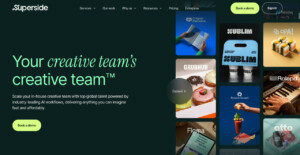
Specializes in: Brand and marketing design on a subscription, including brand systems for companies with several sub-brands.
Headquarters: Remote company (Built In lists Los Angeles)
Founded: 2015
Team size: 800+ per its site (Clutch lists 250 to 999)
Clutch rating: 2.9 from 6 reviews (G2: 4.5 from 115 reviews)
Evaluated on the basis of:
- Design system depth: Partial. Its published proof is brand-level: TransACT, with 13 sub-brands under one parent brand. We found no product UI component system case.
- Tokens and Figma foundations: Not disclosed. Its design systems page does not mention tokens.
- Coded components and tooling: Not offered. Superside hands off to Figma, Storybook or the client’s tools.
- Governance and adoption: Not disclosed.
- Proof and transparency: Partial. Superside reports a 70x increase in TransACT’s design output (vendor-reported). Pricing is public.
Differentiator: A subscription team that keeps producing brand and campaign work on top of the system, so one team applies it every month.
Proof of execution: TransACT: typography, design elements, a grid system and a brand guide covering 13 sub-brands.
Pricing: Subscriptions from $15,000 a month on an annual term; Dedicated teams from $30,000 a month on a 12-month term, plus a $1,000 monthly software fee; a three-week Quick Start costs $20,000.
Potential limitation: Brand systems, not coded product UI. The annual commitment is the largest minimum on this list, and one Clutch reviewer called it very expensive for the output received.
My take: Superside fits an enterprise marketing team that needs a brand system across sub-brands and ongoing production on a subscription. For a product UI system, choose any of the first nine.
How this roster was assessed
We read each agency’s own design system case studies, its services pages, its Clutch profile where one exists and any pricing it publishes. All checks ran on November 8, 2026. We did not hire these agencies to test them. The only first-hand experience in this guide is Fireart’s own work, and its card uses the same fields as the other nine.
The starting pool was about 20 agencies that recur in current design system agency lists and in Google results for design system services. We researched 13 of them in depth, kept the ones that show named client design systems on their own sites, and checked claims copied between listicles against each agency’s own pages. Numbers that come from the agency itself are labeled as vendor-reported.
| Agency | What we checked | Date |
|---|---|---|
| Fireart Studio | CFI case study; UI design and development page; Clutch profile and Revionics review | Nov 8, 2026 |
| Rangle | rangle.io design systems page; Avinode, Sanofi and travel company cases; Radius site | Nov 8, 2026 |
| Southleft | southleft.com PetSmart and CampusIQ projects, tools page, 2026 leadership post; Clutch | Nov 8, 2026 |
| Sparkbox | sparkbox.com Adobe Spectrum, NCSBN and Crown stories; Carbon study; Clutch | Nov 8, 2026 |
| Big Medium | bigmedium.com About page and ExxonMobil Unity and Dotdash projects; Brad Frost’s 2025 announcement | Nov 8, 2026 |
| Directed Edges | directededges.com Nathan Curtis page; EightShapes closure notice; Specs documentation | Nov 8, 2026 |
| Clearleft | clearleft.com UCL, Incisive Media and UAL cases; services page; Clutch | Nov 8, 2026 |
| thoughtbot | thoughtbot.com design systems page, Eigen and LawBite cases, handoff guide; Clutch | Nov 8, 2026 |
| Netguru | netguru.com design systems page, Silk and Sportano cases; Clutch | Nov 8, 2026 |
| Superside | superside.com design systems and pricing pages, TransACT story; Clutch and G2 | Nov 8, 2026 |
We also checked DOOR3, Metalab and EightShapes. DOOR3 has a design system services page but one client case with a component library, and its published price tiers contradict its own FAQ. Metalab lists “Design System” as a deliverable on one project without a case study. EightShapes closed on June 30, 2024 and now points design system work to Directed Edges. We also found a design system claim about Vimeo in another agency list that the agency’s own Vimeo case study does not support, so it is not used here.
What does a design system engagement actually include?
Seven layers of work share the label “design system”, and few agencies are strong at all seven. A Figma UI kit covers one or two of them. A system that product teams adopt covers most of them, and the last two decide whether it survives.
| Layer | What you get | Agencies on this list with public proof |
|---|---|---|
| Audit and inventory | Every existing UI pattern listed, duplicates flagged, a roadmap | thoughtbot, Clearleft |
| Foundations and tokens | Color, type, spacing and themes as tokens, ideally in the DTCG format | Rangle, Southleft, Clearleft, Netguru |
| Figma library | Components with variants, properties and usage notes | Fireart Studio, thoughtbot, Netguru |
| Coded components | React, web components or another framework, tested and versioned | Rangle, Southleft, Sparkbox |
| Documentation | Storybook or a documentation site with usage guidance and code | Sparkbox, Clearleft, Big Medium |
| Governance and adoption | An owner, a contribution process, training and adoption metrics | Big Medium, Directed Edges, Rangle, Sparkbox |
| Brand system | Identity, typography and grids for marketing across sub-brands | Superside |
If your engineers would rather start from an open-source library than build components from zero, our roundup of React UI frameworks and component libraries compares the usual starting points. Rangle and Southleft both build client systems on shadcn/ui, which shows how common that route has become.
What changed for design systems in 2025 and 2026?
Three things moved from “nice to have” to “ask about it in the first call”: a stable token format, AI coding agents that read your design system, and accessibility law in the EU. An agency proposal written in 2023 can miss all three.
Design tokens got a stable standard. On October 28, 2025, the W3C Design Tokens Community Group published the first stable version of its specification, 2025.10. It defines one JSON format for colors, spacing, type and other tokens, so Figma, a token build tool and your codebase can read the same file. The group calls the spec stable, though it is a Community Group report rather than a formal W3C standard. Tokens were already common: in zeroheight’s survey of 294 practitioners, use rose from 56% of teams in 2024 to 84% in the 2025 report. Ask any design system agency whether it exports tokens in the DTCG format and how it handles themes and modes.
AI coding agents now read your system. Figma released its Dev Mode MCP server in public beta on June 4, 2025. It passes components, variables and layout from a Figma file to coding agents in tools like VS Code, Cursor and Claude Code, and with Code Connect mapped, the agent can call your real coded components instead of writing new ones. The quality of what comes out depends on the quality of the system going in: clean component names, real variables and a mapping between Figma and code. A messy library produces messy generated code faster.
Multi-brand theming got a native Figma feature, with a catch. Extended collections, announced at Schema 2025 and released in November 2025, let one parent collection of variables feed several brands with overrides. Figma’s help center lists the feature for Full seats on the Enterprise plan only, so a multi-brand plan built on it assumes that plan.
Accessibility became a legal requirement for many EU products. The European Accessibility Act has applied since June 28, 2025 to covered products and services sold in the EU, including e-commerce, consumer banking and e-books. Compliance is usually shown through EN 301 549, which references WCAG 2.1 Level AA for web content. A design system is where most of that work lives: contrast in color tokens, focus states in every component, accessible names in coded components. If you sell into the EU, ask the agency to show the accessibility documentation for one real component rather than a contrast checker screenshot.
Why do design systems stall after launch?
Most stall because nobody owns them after the agency leaves, not because the components were badly drawn. A system is a product with users, a backlog and releases. Treat it as a one-time deliverable and it starts to drift within a few sprints.
No owner after handover. In zeroheight’s 2025 report, 79% of teams said they had a dedicated design system team, full-time or partly resourced, and 81% of the most widely adopted systems had one. Even so, 41% of respondents at companies under 500 people and 54% at larger ones said they did not have enough people. Before you sign, name the person inside your company who will run the system the day the agency’s contract ends.
Figma and code drift apart. Designers update the library, engineers keep a fork of last quarter’s button, and within months the two sources of truth disagree. Token files in one shared format, Code Connect mappings and a release process for both sides slow this down. An agency that only delivers a Figma file leaves this problem with you.
Built for one product, pushed onto five. A system designed around one app’s screens often breaks when a second team with different data, density or platform tries to use it. If more than one product will use the system, put people from those teams into the audit and the first component reviews.
Documentation nobody opens. A 90-page PDF of guidelines does not get read during a sprint. Documentation that sits next to the code, in Storybook or a documentation site, with do and don’t examples and copy-paste snippets, does.
Adoption is never measured. If you cannot say what share of your screens use system components, you cannot tell whether the system is working. Ask the agency how it will measure adoption and what the number should be at 6 and 12 months.
How much does a design system cost in 2026?
For the agencies here that publish rates, hourly prices run from $50 to $300+ and minimum projects from $10,000 to $50,000. Superside sells a subscription instead, from $15,000 a month on an annual term. The total depends less on the rate than on how many layers you buy: a Figma library alone is a fraction of a coded, documented and governed system.
| Agency | Hourly rate | Minimum project | Model |
|---|---|---|---|
| Fireart Studio | $50 to $99 | $10,000+ | Project or embedded design team |
| Netguru | $50 to $99 | $50,000+ | Dedicated team |
| thoughtbot | $150 to $199 | $10,000+ | Project or embedded team |
| Sparkbox | $150 to $199 | $50,000+ | Embedded team |
| Southleft | Not disclosed | $10,000+ | Partner or embedded engineers |
| Clearleft | $300+ | Not disclosed | Project with your team |
| Superside | Subscription | $15,000 a month, annual term | Flex or Dedicated subscription |
| Rangle | Not published | Not published | 4 to 8 week builds and longer partnerships |
| Big Medium | Not published | Not published | Coaching and project work |
| Directed Edges | Not published | Not published | Embedded leader or advisor, 9+ months |
Rates and minimums from Clutch on November 8, 2026; Superside and Rangle from their own sites.
Here is a worked example for one web product with 30 core components. The hours are our illustration, not a quote from any agency on this list:
- Audit and inventory: 40 hours
- Foundations and tokens: 60 hours
- 30 Figma components at 6 hours each: 180 hours
- 30 coded React components with Storybook stories at 10 hours each: 300 hours
- Documentation: 80 hours
- Handover and training: 40 hours
That is 700 hours. At $50 to $99 an hour it costs $35,000 to $69,300. At $150 to $199 it costs $105,000 to $139,300, and at $300 an hour, $210,000.
Now the payback side, using Sparkbox’s Carbon test. The median form took 4.2 hours from scratch and 2 hours with the system, a saving of 2.2 hours. If your engineers build 20 features of that size a month, that is 44 hours a month, or 528 hours a year. At an internal cost of $100 an hour, the saving is $52,800 a year, and a $35,000 to $69,300 build pays for itself in about 8 to 16 months. Two caveats: Sparkbox tested one simple form with eight developers, and a system needs upkeep after launch, so plan budget for an owner.
For the wider product budget around the system, our guide to calculating product design cost breaks down research, UX, UI and handoff.
What to ask a design system agency before you sign
Ask for evidence you can open, not slides. A good design system agency can answer most of these with a link.
- Can you show a live design system you built, with its documentation site or Storybook, and tell us who maintains it today?
- Which parts will you deliver in code, and in which framework? React components, web components or Figma only?
- Do you export tokens in the DTCG 2025.10 format, and how do you handle light and dark modes, platforms and brands?
- How will our coding agents use the system? Do you set up Code Connect or the Figma MCP server, or document it for our engineers?
- Which WCAG 2.1 or 2.2 criteria does each component meet, and where is that written down?
- Who on our side owns the system after handover, and what training does that person get?
- How do other teams contribute a new component, and who approves it?
- How will you measure adoption, and what should the number be six months after launch?
- Which part of the work will a subcontractor or freelancer do, if any?
Which design system agency should you choose?
Start from the situation you are in. The table gives a first call and a second option for each one.
| Your situation | Start with | Also consider |
|---|---|---|
| Redesigning a product and want the system built during the work, design plus front end, mid-range budget | Fireart Studio | Netguru |
| Need a tokenized foundation with a coded library and visual tests in weeks | Rangle | Southleft |
| Want coded components and tooling that AI coding agents can use | Southleft | Rangle |
| An existing enterprise system needs migration, documentation or governance | Sparkbox | Clearleft |
| Several brands or products, and adoption is the real problem | Big Medium | Directed Edges |
| An in-house system team needs a senior architect or program lead | Directed Edges | Big Medium |
| UK or EU university, public body or media group building skills in-house | Clearleft | Sparkbox |
| Web or Rails product with design debt that needs an audit first | thoughtbot | Clearleft |
| One large team to build the system and the whole app, $50,000+ | Netguru | Fireart Studio |
| Marketing team needs a brand system across sub-brands plus ongoing production | Superside | Clearleft, if the brands share websites |
FAQ
What does a design system agency do?
A design systems agency audits your current interface, defines tokens for color, type and spacing, builds a component library in Figma and often in code, and writes the documentation teams use. The better ones also set up an owner, a contribution process and adoption tracking, so the system keeps working after the contract ends.
How much does a design system cost in 2026?
Rates on this list run from $50 to $300+ an hour, with minimum projects from $10,000 to $50,000, and Superside sells subscriptions from $15,000 a month. In our worked example, a 700-hour system with 30 coded components costs $35,000 to $69,300 at $50 to $99 an hour, and $105,000 to $139,300 at $150 to $199.
How long does it take to build a design system?
A first foundation can take weeks. Rangle delivered Avinode’s in six weeks, and Clearleft’s UAL engagement ran nine weeks. Broader systems take longer: Rangle says comprehensive systems take three to six months, Clearleft’s UCL work took five months, and Rangle’s Sanofi system took under ten. Adoption across teams goes on after launch.
Is a Figma library enough, or do we need coded components?
A Figma library is enough only while one small team builds the product and checks every screen by hand. Once several teams or AI coding tools write UI, coded components stop the drift, because engineers import the same button instead of rebuilding it. Code Connect can then link each Figma component to its coded version.
Should we hire design system companies or build an in-house team?
Most companies need both. Agencies and other design system companies help with the first build, an audit or a stalled program, but someone inside has to own the system afterward. In zeroheight’s 2025 report, 79% of teams had a dedicated design system team, full-time or partly resourced, and 81% of the most widely adopted systems had one.
What are design tokens, and does the format matter?
Design tokens store design decisions such as colors, spacing and type sizes as named values that design tools and code both read. The format matters more since October 2025, when the W3C Design Tokens Community Group published its first stable specification, 2025.10. Tokens in that JSON format move between Figma, build tools and code with less conversion.
Conclusion
The ten agencies here solve different parts of the problem. Rangle and Southleft show the most coded, tokenized work, and Southleft leads on tooling for AI agents. Sparkbox is the team to call for an enterprise system that already exists. Big Medium and Directed Edges work on strategy and adoption, Clearleft builds systems with your team in the UK and EU, and thoughtbot, Netguru and Superside cover audits, full app builds and brand systems. Pick the agency for the layer you cannot cover yourself, then compare rates.
If you are about to redesign a product and want the design system built in the same project, by a team that can also write the front end, that is the work we did for CFI. See our UI design and development and product design services, or tell us about your product and we’ll say plainly if another team on this list fits better.





 Kotlin
 C++
 C#
 Ruby on Rails
 Java
 Firebase
 Python
 Vue.js
 HTML5
 CSS3
 Azure