

Founders and product leaders weigh the cost of an in-house designer vs agency partnership to scale products. Usually, this calculation begins with a flawed premise: comparing an employee’s base salary directly against an agency’s hourly rate or project invoice.
This math hides the financial exposure of building a product team. When you hire an in-house designer, the salary is the starting point. You are committing to recruitment fees, employee benefits, software licenses, and the cost of management overhead. You are absorbing the cost of downtime. An employee remains a liability even when your product roadmap slows down.
Conversely, when you hire a design agency, the price looks higher. However, that fee bundles quality assurance, project management, access to skills, and the flexibility to scale capacity up or down instantly.
At Fireart, we help companies navigate this transition. Whether we are augmenting a team or building a SaaS platform, we see how these financial models make or break a company’s runway.
This guide breaks down the design agency vs in-house designer economics for 2026. We look beyond the rates to uncover the cost of ownership, providing scenarios to help you decide which model makes sense for your business.
Article highlights
- Comparing a designer’s salary to an agency invoice is a trap. The employer cost of a hire is roughly 30% to 40% higher than their base pay.
- Internal teams excel in predictable environments where brand continuity is the goal.
- Agencies provide the speed, scalability, and skills required to execute product launches without the overhead of salaries.
- The choice comes down to utilization. A hire becomes a liability if they sit idle between product releases.
Delivery starts on day one
See our product design servicesThe cost comparison
How do you compare an agency vs in-house designer? You look at how money behaves in both models. The efficiency of your choice depends on your utilization rate, project duration, and the expertise your product requires.
If your team has a predictable backlog of UI updates, a hire is an investment. If your workload fluctuates, or you are building a platform, an agency prevents you from paying for capacity when the roadmap slows down.
Before we dive into the 2026 figures, here is a look at how the responsibilities break down.
| Cost factor | In-house designer | Design agency |
|---|---|---|
| Base cost | Annual salary | Project, retainer, or hourly fee |
| Recruitment & onboarding | High (time, HR resources, recruiter fees) | None (pre-vetted team assembly) |
| Benefits & payroll taxes | Yes (approx. 30% overhead) | Included in the fee |
| Software & hardware | Employer pays | Included in the fee |
| Management overhead | High (requires review and guidance) | Low (usually self-managed) |
| Access to skills | Limited to one person’s strengths | Broad (UX, UI, motion, research) |
| Scaling capacity | Slow (typically 30-45 days to hire) | Fast (onboarded in days) |
| Downtime cost | High (salary regardless of work) | Low (can pause or scale down) |
Calculating agency vs in-house design cost requires looking at the cost of ownership. A freelancer or hire’s hourly breakdown might look cheaper on paper, but that math ignores the reality of managing and equipping a product team.
What does an in-house designer cost in 2026?
The salary creates a baseline for your runway. To calculate your in-house designer cost, you have to look at the burden required to keep an employee employed and equipped.
Let’s look at the 2026 math for hiring a product designer in the United States.
The base salary
According to the 2026 salary benchmarks from Robert Half, the starting salary for a product designer is $128,000.
The employer burden
This is where the math shifts. According to the U.S. Bureau of Labor Statistics (BLS), an employee’s base wage accounts for about 68.5% of their cost to the employer.
The remaining 31.5% goes to employer burdens. To calculate this, financial teams use a multiplier (roughly 1.46x the base wage). This means you must add $50,829 to our designer’s baseline to cover:
- Health Insurance: $15,884
- Paid Time Off (PTO) & Sick Leave: $15,136
- Statutory Taxes (FICA, FUTA, SUTA): $13,082
- Retirement / 401(k) Match: $6,727
Before the designer has opened their laptop, your $128,000 hire costs $178,000 annually.
Recruitment and software
The Society for Human Resource Management (SHRM) places the average non-executive cost-per-hire at $5,475. This accounts for job board fees, HR screening time, and background checks.
Next comes the software burden: a seat for Figma alongside an Adobe Creative Cloud license totals $2,424 per year.
The first-year commitment
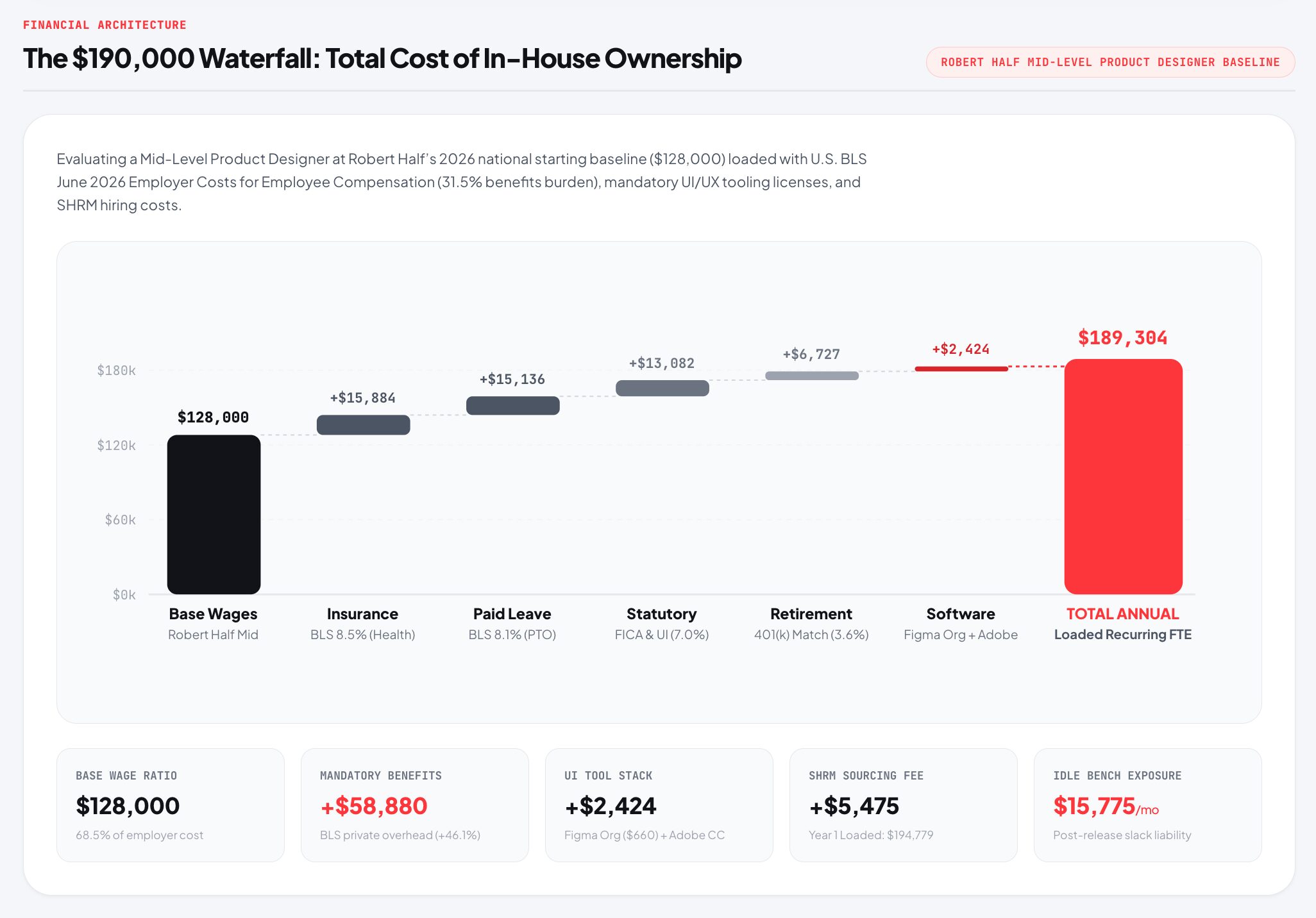
When you add the base salary, the BLS benefits burden, and the tooling stack, the cost of your designer sits at $189,304.
In year one, you must add the $5,475 SHRM hiring cost. This brings the first-year commitment of a 128k in-house product designer to $194,779.
This is the number you must use when comparing an agency vs in-house design cost.
Design agency pricing
When founders see an agency rate of $150 per hour, the reaction is shock. If you divide a base salary by 2,080 working hours, the in-house route looks cheaper. That math is an illusion.
When you hire a design agency, you are buying an outcome. The premium you pay on the hourly or project rate absorbs the liabilities – hardware, software, recruiting, and bench time – mapped out above.
Agency pricing approaches
Agencies operate on two models that make sense for product teams: fixed-scope projects and retainers.
For fixed-scope work, you pay for a deliverable. Based on 2026 data from Clutch, engaging an agency to design a SaaS MVP requires a commitment of $10,000 to $25,000, with timelines running six to eight weeks.
If you need capacity without the HR overhead, retainers are the route. A designer from an Eastern European agency runs about $6,600 per month. That equates to $79,000 a year. When navigating IT outsourcing costs, this model provides capacity at less than half the cost of a US hire, with no severance risk if your funding dries up.
What the agency fee covers
A mistake in evaluating an agency vs in-house designer is assuming the output is 1:1. An agency invoice bundles a pod.
While a product designer drives execution, that agency rate covers access to a UX researcher, a motion specialist, a design director who handles quality assurance, and a project manager handling the drag. You get the capability of a department without carrying salaries on your payroll.
Contract traps
Agencies protect their margins. If your team is disorganized, that invoice will inflate.
Our audit of 2026 rate cards revealed penalty clauses that product owners must watch out for. Need to compress the timeline? Rush turnarounds trigger a 25% to 50% surcharge on the project. Did your stakeholders change their minds after sign-off? Revision rounds are gated, billed at $250 to $500 per screen.
Agencies penalize delays. If your team fails to provide feedback and the project goes dormant for 45 days, contracts include a reinstatement or startup fee – reaching $1,000 – to get your project back on their schedule. Agencies offer flexibility, provided you maintain discipline.
Expand your capacity overnight and bypass the recruitment funnel
Review augmentation servicesAgency vs in-house: Three scenarios
How does the agency vs in-house design cost play out in practice? The decision comes down to utilization and scope. Here is how the models apply to product lifecycles.
The 3-month MVP sprint
You secured funding and need to build a prototype.
If you hire an in-house designer, you will lose weeks navigating the applicant tracking system before work begins. The labor cost for a three-month sprint is $46,700. Once the design is handed off to engineering, your design needs drop. That employee is sitting idle, creating a carrying cost of $15,700 a month.
An agency can deploy a pod immediately. While a three-month engagement might cost $54,000, the contract terminates when the work is done. You avoid $100,000 in carrying costs. For concentrated work, teams provide agility without risks.
Product iteration
Your SaaS product has achieved product-market fit. You have a backlog of feature releases, user testing, and micro-optimizations.
At this stage, an agency retainer providing a team could run $20,000 to $25,000 a month, totaling $240,000 annually.
Meanwhile, the cost of a designer is $189,304. Because the roadmap guarantees that this designer will remain at 85% utilization or higher throughout the year, the math flips. When domain knowledge compounds and the workload never dips, building a capability is the choice.
The product overhaul
Your enterprise platform is outdated. You need to conduct user research, build a design system, and implement UI motion.
You cannot expect one person to be a master of user research, visual design, and motion physics. Building a team of three specialists requires a first-year commitment of $415,000 in salaries, taxes, software, and recruitment fees.
Engaging one of the top product design companies on a retainer gives you access to all three specialists for $240,000 a year. You save $175,000 in your first year while securing expertise across every discipline.
Friction points to consider
While models dictate the baseline, friction decides the winner in the in-house designer vs agency debate.
The designer fallacy
When companies hire an in-house designer early on, they expect a unicorn. They want one person to moderate user research sessions, architect the design system, and animate micro-interactions.
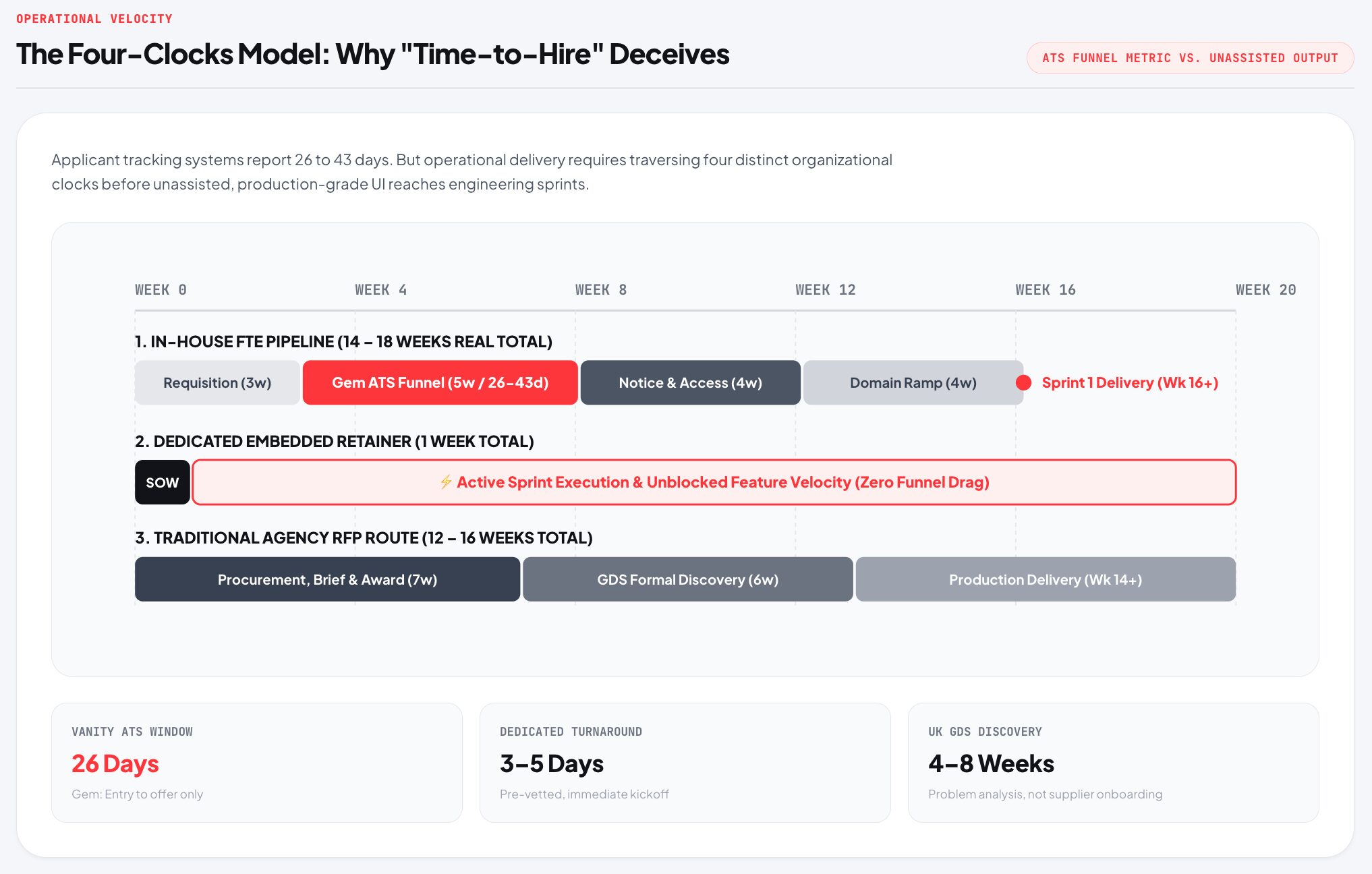
This creates a bottleneck. Delivery frameworks warn against compressing research, accessibility validation, and interaction design into a role. A designer testing their UI lacks objectivity, while tasks like UI motion require choreography and compliance. When a generalist attempts to juggle this, delivery stalls.
The management drain
If you do not have a design director on staff, the burden of managing a hire falls onto product managers or founders. Without leadership to provide critiques, PMs are dragged into debates. You pay a premium for a product manager to act as a reviewer.
The speed trap
When calculating the speed of an agency vs in-house designer, companies miscalculate lead time. Benchmark data shows the time-to-hire for design roles is 26 days. It covers the time a candidate spends in the applicant tracking system (ATS).
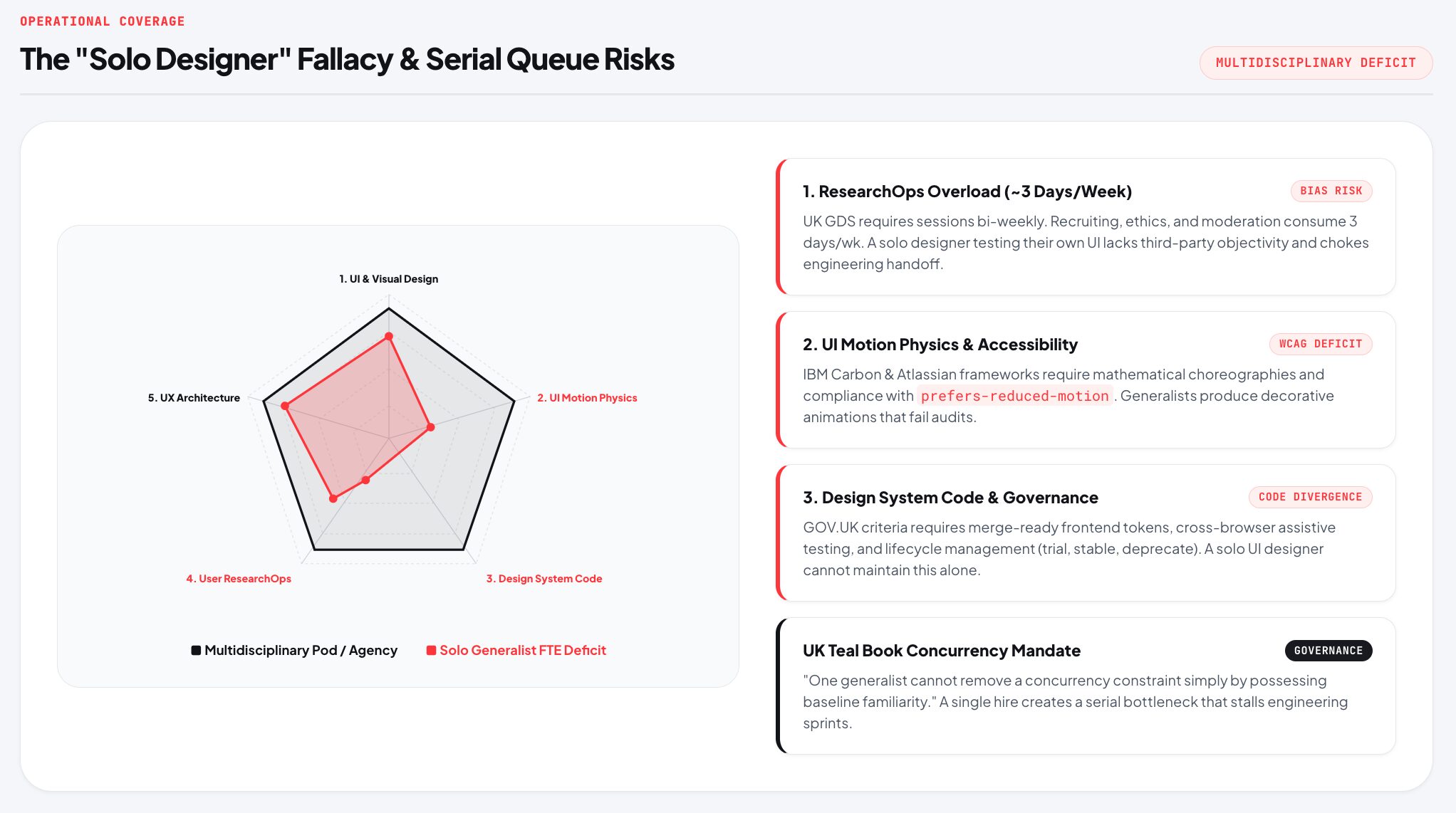
When you factor in requisition approvals, four-week notice periods, IT setup, and domain onboarding, your time-to-capacity is 14 or 18 weeks. If you hire a design agency or sign a retainer, that team bypasses the HR funnel and begins sprinting within days.
The agency bait and switch
Partners come with friction. A complaint from product owners is the bait and switch – agencies that win the contract using creative directors, and hand the execution off to designers.
To prevent this, ensure your contract guarantees oversight and mandates that the team collaborates with your developers from day one.
Making the call
There is no winner in the design agency vs in-house designer debate. The choice is a matter of alignment between your product roadmap and your balance sheet.
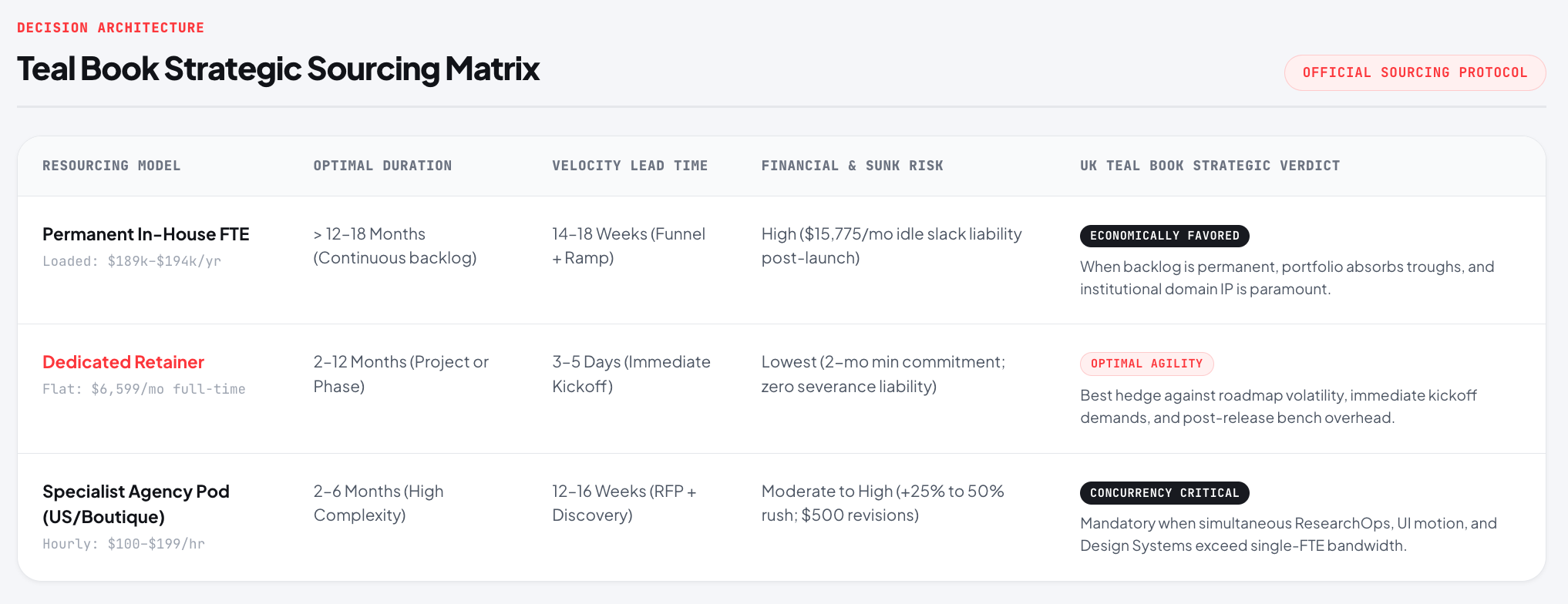
If your product requires domain knowledge and you can guarantee a workload for the next year and a half, it is time to hire an in-house designer. The in-house designer cost pays off when that knowledge compounds over release cycles.
However, if your workload fluctuates, or if you need to launch a platform requiring research, motion, and visual design, you should hire a design agency. Partners provide the agility to scale up during a launch and scale down when the lifting is done, protecting your runway from bench time.
You don’t always have to make a choice. At Fireart Studio, we provide design team augmentation that integrates with your product leaders. You get the capacity you need, right when you need it.
Pair your product vision with a team that knows how to execute
Connect with usFAQ: Design agency vs in-house designer
Is it cheaper to hire an in-house designer or a design agency?
It depends on utilization. An agency is cost-effective for project-based work (under 6 to 9 months) because you do not absorb carrying costs. For multi-year product iteration, a hire becomes economical.
What is the cost of an in-house designer in 2026?
Look beyond the salary. Factoring in the 30% to 40% burden for benefits, taxes, software seats, and recruitment fees, a $128,000 base salary translates to a first-year commitment of $195,000.
When should you hire a design agency instead of a designer?
Bring in an agency when you have a spike in workload, need to bypass the 14-to-18-week hiring cycle, or require a mix of skills that a generalist cannot execute alone.
How do you compare an agency vs in-house designer when reviewing costs?
You have to compare the cost of ownership. Agency fees bundle the designers’ time, software licenses, project management, and quality assurance. When calculating costs, you must add expenses on top of the payroll.
Can a design agency replace an in-house design team?
Yes, particularly for startups or companies running operations. However, many companies prefer a hybrid approach – keeping a product manager or design lead while leveraging an agency for execution.



 Kotlin
  C++
C++  C#
C#  Ruby on Rails
  Java
Java  Firebase
  Python
  Vue.js
  HTML5
HTML5  CSS3
CSS3  Azure
Azure