

If you are projecting your fintech app development cost for an upcoming launch, you have likely seen this: one agency quotes $60,000, while another demands $300,000 for the same feature list.
A fintech budget is decided by architectural choices, compliance standards, and UX decisions that prevent users from abandoning the app. A cheap app with a broken KYC flow is a liability.
Wondering how much does it cost to build a fintech app? While front-end engineering for a prototype might sit around $60,000, factoring in ledger architecture, security audits, and sponsor bank integrations pushes a 2026 launch budget into the $150,000–$300,000+ range.
When Fireart handled the CFI fintech platform redesign, we saw firsthand that building an interface that instills financial trust requires more than UI kits. This guide will show you where the money goes.
Article highlights
- Custom builds require millions in capital while Banking-as-a-Service models shift your financial burden to monthly operating costs.
- High user drop-off during identity checks drains marketing budgets. Good UX design prevents users from abandoning your app mid-registration.
- Launching in the US or UK requires specific capital reserves and security audits that significantly inflate development budgets.
- Sponsor banks reject products without security attestations. Budgeting for audits like SOC 2 is essential for a fintech launch.
- Retail BaaS tools offer zero upfront costs but limit interchange revenue. Enterprise models demand setup fees for wholesale rates.
- Cheap estimates often omit expensive security requirements. Professional quotes prioritize immutable ledgers and regulatory compliance to avoid bank rejection.
- Operational expenses scale with users. Unoptimized apps drain margins through excessive API calls for balance checks and identity verification.
- Budget up to 25% of development costs annually for maintenance. This covers security patches and compliance with shifting regulations.
- Design systems reduce engineering hours by 33%. Reusable components pay for the design phase by speeding up frontend development.
- A fintech budget is decided by architectural choices and compliance standards that prevent users from abandoning the app.
Table of contents
Deliver a mobile banking app that balances high security with a great user flow
See our banking approachFintech app development cost in 2026 at a glance
When searching for the cost to develop fintech app, founders look for a baseline. The numbers in the table below represent software engineering costs (Capital Expenditure). This covers building the interface, logic, and API connections.
| App Category | MVP | Mid-Tier | Enterprise Platform |
|---|---|---|---|
| Payments & Wallets | $40,000 – $80,000 | $150,000 – $250,000 | $300,000+ |
| Neobanks / Digital Banking | $100,000 – $200,000 | $250,000 – $450,000 | $600,000+ |
| Wealthtech & Trading | $70,000 – $150,000 | $200,000 – $400,000 | $500,000+ |
| Lending & Credit | $50,000 – $120,000 | $150,000 – $300,000 | $400,000+ |
Whether you are calculating a neobank app development cost or mapping out a trading app development cost, stopping at the fintech software development cost is an oversight. An app built on a $50,000 budget is useless if blocked by your sponsor bank for failing compliance.
To understand your app development cost and runway, you must factor in infrastructure and compliance. The banking app development cost relies on choices like these:
- BaaS implementation (CapEx). You can pay $0 upfront using a retail provider like Stripe Issuing, or you can invest $50,000–$150,000+ for enterprise Banking-as-a-Service implementation (like Marqeta) to secure wholesale rates.
- Regulatory capital. In the UK, the FCA requires €350,000 in capital to hold an Authorized Electronic Money Institution (EMI) license. You must hold this money in reserve.
- Security audits. Sponsor banks will not touch your product without a SOC 2 Type 2 attestation. A budget for this audit runs between $20,000 and $80,000+.
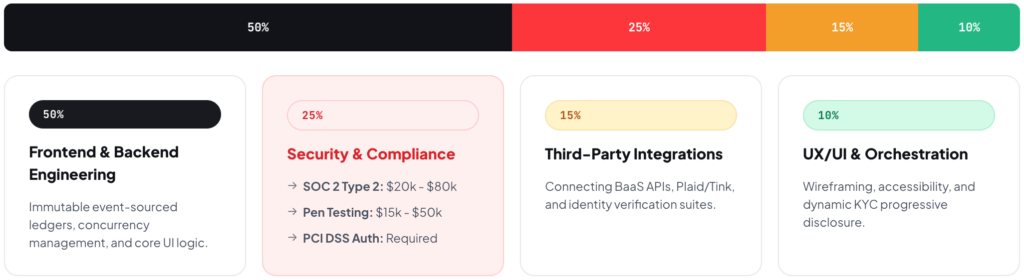
The expenses that dictate your budget live in third-party integrations, immutable data ledgers, and ongoing compliance. Let’s look at the decisions that shape these costs.
The architectural foundation: Build, BaaS, or white-label
The choice that dictates the cost to build a fintech app over its first 24 months is how you engineer the ledger and banking core.
You have three options: rent an app, partner with a middleware provider, or build from scratch. Your decision shifts your financial burden from Capital Expenditure (CapEx) to monthly burn (OpEx).
Wondering how to integrate BaaS APIs into a fintech app without bleeding cash? It comes down to knowing your growth threshold.
If you opt for a white-label fintech platform, you pay a setup fee and launch in weeks. However, you sacrifice interchange revenue and brand control. Building a custom core ledger linked to a sponsor bank grants you control and margins, but requires a capital investment of $1.5M to $3M before you process a transaction.
Bring your fintech to the market with a lean, functional, and fully compliant MVP
See MVP processFor the majority of startups, banking as a service (BaaS) is the optimal choice. Within BaaS, the economics scale differently.
- Retail BaaS (e.g., Stripe Issuing): You pay $0 in implementation and face no monthly minimums. You can issue virtual cards for $0.10. It is perfect for payment app development, but the provider takes a cut of your interchange revenue, capping your margins at 70 basis points (bps).
- Enterprise BaaS (e.g., Marqeta, Synctera): You pay a $50,000 to $150,000+ implementation fee and commit to monthly minimums ranging from $5,000 to $15,000. In exchange, you secure wholesale rates, keeping up to 150 bps of the interchange yield.
Here is how these choices alter your budget map.
| Architecture Model | CapEx | Unit Economics & Margins | Time to Market | Vendor Lock-in |
|---|---|---|---|---|
| White-label apps | $10K – $30K | Poor | 4-8 weeks | Extreme |
| Retail BaaS | $0 | Moderate | 3-5 months | High |
| Enterprise BaaS | $50,000 – $150,000+ | High | 6-9 months | Moderate |
| Custom build | $1.5M – $3.0M+ | Maximum | 18-24 months | None |
In financial modeling, an enterprise BaaS becomes profitable at the $50M/month transaction volume threshold. If your projections sit below that, absorbing a $150k setup fee will drown your startup before it scales. By defining your architecture, you protect your margins and ensure your infrastructure budget scales with your revenue.
How UX decisions protect your fintech budget
Excellent fintech UX design is a protective barrier for your customer acquisition cost (CAC).
The math of design is evident during the KYC onboarding flow. According to European consumer research by Signicat, 68% of users have abandoned financial applications midway through the process.
Every time a user tries to upload an ID and fails because your app lacks glare detection, you bleed cash. If an identity check costs $1.35 and a user retries three times before triggering a compliance review, that $1.35 baseline balloons to $15.00 in analyst time and API fees. If they abandon the app, you forfeit the $150+ spent on marketing to acquire them. A progressive disclosure design prevents this leak.
Wondering how UI UX design manipulates your fintech app development cost? It happens through component reuse and engineering efficiency.
Building financial dashboards and data visualizations from scratch for every feature burns developer hours. By investing in a design system with matching front-end components, you cut coding time. For instance, Lloyds Banking Group reported that implementing a design system saved 50% of their designers’ time and 33% of their developers’ time. When paying engineers $100+ per hour to build secure fintech solutions, a 33% reduction in front-end coding pays for the design phase.
Translate complex financial logic into a mobile app
See mobile solutionsThe regulatory tax: US, UK, and UAE checklists
Regulations dictate your database architecture, cloud hosting environment, and user flows.
Wondering how much of your fintech software development cost should go toward security and legal hurdles? Your geographic footprint in 2026 determines your capital stack and software architecture.
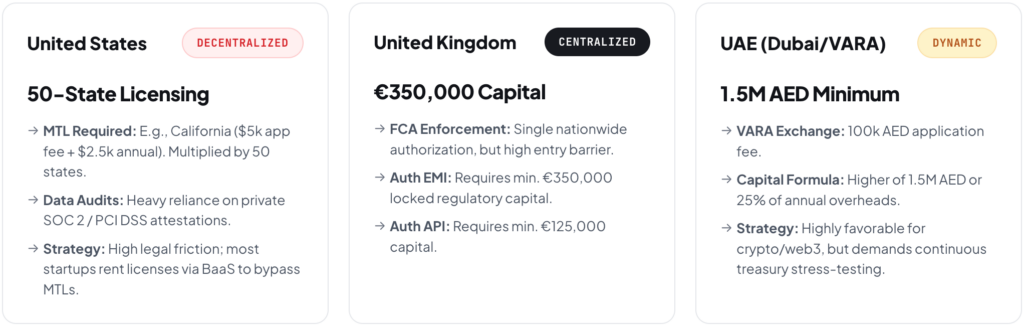
The United States: decentralized friction and audits
Operating in the US means navigating fragmented regulations. There is no federal fintech charter; you must acquire Money Transmitter Licenses (MTLs) state by state. In California, the DFPI charges a $5,000 application fee plus a $2,500 annual fee – multiply that friction across 50 states.
Beyond state licenses, your sponsor bank will force you to prove your security posture. Achieving a SOC 2 Type 2 attestation costs between $20,000 and $80,000+. If you handle card data, the engineering hours required to achieve PCI DSS compliance will inflate your backend budget.
The United Kingdom: centralized structure and capital requirements
The UK relies on a centralized architecture overseen by the Financial Conduct Authority (FCA). The barrier to entry is capital.
If you are building a digital banking platform that issues electronic money, the FCA requires you to hold €350,000 in capital for an Authorized Electronic Money Institution (EMI) license. Handling KYC/AML compliance requires embedding screening and resilience logic into your backend code, or the FCA will reject your application.
The UAE: dynamic capital for digital assets
The UAE has engineered a matrix of economic zones, making it a hub for crypto.
How to budget for a stablecoin wallet or digital asset exchange? Look to Dubai’s Virtual Assets Regulatory Authority (VARA). VARA uses expenditure-based capital requirements. An exchange license carries a 100,000 AED ($27k) application fee, but you must maintain capital equal to the higher of 1.5 million AED or 25% of your overheads.
Launching in any of these markets requires treating compliance as the blueprint for your development cycle.
The shadow burn rate: operational costs
Errors in fintech budgeting occur post-launch. Founders secure capital to build the product, but fail to account for the burn rate – the operational expenses that scale with your user base but do not generate revenue.
How to plan for a payment app development cost that doesn’t balloon within six months of going live? You must map out the API fees that trigger when a user registers, connects a bank, or moves money.
Building a fintech app with card issuing capabilities? Stripe Issuing charges $0.10 for every virtual card you generate. Relying on open banking? Plaid charges between $0.10 and $0.60 per API call, meaning an unoptimized app that pings a user’s balance frequently will drain your margin.
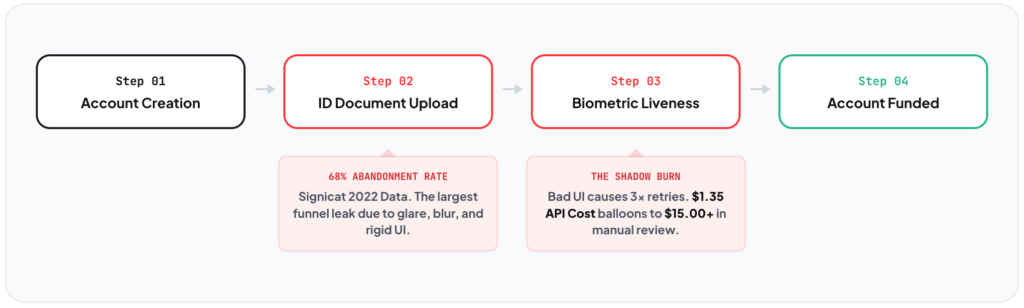
The killer is the onboarding tax. If you use a provider like Sumsub, an identity verification costs $1.35 per check. If a user takes a selfie and fails the check, you are billed. If your app has a 15% drop-off rate, you burn dollars on API fees for users who never fund their accounts. Managing these third party integrations requires backend logic to prevent duplicate calls.
Beyond API usage, you must account for data retention laws that govern financial services. Regulations require you to store KYC documents and biometric videos for up to seven years. Maintaining this Personally Identifiable Information (PII) in cloud environments costs $0.30 per user, per month. For an app with 100,000 users, that is a $30,000 infrastructure burden for storage.
Wondering how to project your fintech app maintenance cost? A baseline is to budget 15% to 25% of your development cost every year. This covers cloud scaling, security patching, and the engineering overhead required to keep your BaaS connections compliant as regulations shift.
Partner with a team that aligns code with your compliance realities
View product design servicesHow to read a fintech development estimate
If an agency promises to build a neobank for $60,000, run. They are building a prototype that your sponsor bank will reject.
Wondering how to read a fintech development app estimate before you sign? You must look at what the vendor excluded. Certain quotes depress the budget by stripping out infrastructure.
If an agency pitches a fintech MVP cost, they are likely skipping the $15,000 to $50,000 required for penetration testing and the engineering hours needed for PCI DSS certification. They will cut corners on your database architecture. Cheap builds rely on relational databases that overwrite data states. In financial services, overwriting a state destroys the audit trail, violating AML regulations. An estimate scopes an immutable, event-sourced ledger.
What drives the cost to develop fintech app solutions is the ability to adapt to regulatory shifts mid-build. This is why fixed-price contracts are a red flag in this industry.
A fixed-price model incentivizes the vendor to finish tasks quickly, putting them in a defensive posture. When architecture is rushed, developers skip code refactoring and ignore compliance logic. Because the regulatory landscape shifts, every pivot triggers a change order fee, blowing past the budget.
For software, Time and Materials (T&M) or dedicated team models are safer. They align the vendor’s incentives with product quality. This allows your MVP development to adapt to compliance shifts, open banking APIs, and user feedback without breaking the contract.
A quote will define the discovery and UX phases, dedicate a percentage of hours to QA testing, and state compliance exclusions and API assumptions.
How Fireart builds fintech that scales
So how to design a fintech app that doesn’t buckle under scrutiny? You need a partner who understands that interface design and backend architecture are inseparable.
At Fireart, we engineer scalable products. When we partnered with CFI, a trading provider, the challenge was unifying a user experience across web and mobile applications without disrupting their user base.
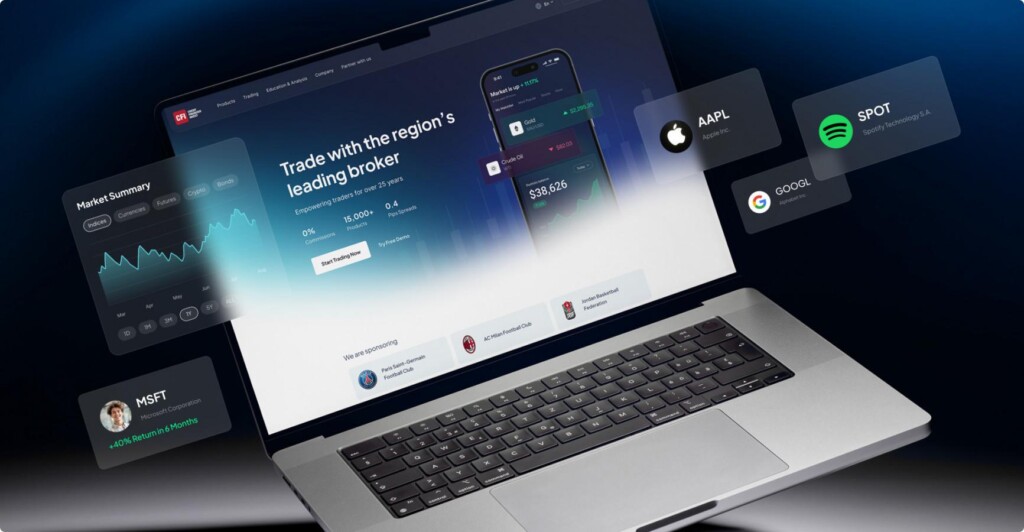
We developed a design system. This reduced the front-end coding hours required for future updates, optimizing their fintech app development cost. By implementing progressive disclosure in their trading dashboards, we reduced cognitive load and helped traders execute faster, driving an increase in user engagement across the platform.
“An interface is useless if it causes a 60% drop-off at the KYC checkpoint or fails a sponsor bank’s security audit,” notes our Head of Product Design. “We map out the compliance constraints, error states, and API calls before we open Figma. That is how you protect a startup’s runway.”
Share your fintech vision with us and we will give you a roadmap to make it a reality
Contact Fireart for a scoped estimateConclusion
The fintech app development cost is established during the discovery and architecture phases. Whether you choose a custom build or leverage a BaaS to get to market, every technical and UX decision either protects your runway or bleeds it dry.
Stop guessing your budget based on tables. If you want a platform that converts users, passes audits, and scales, you need a partner who understands the economics of financial software.
FAQ: Common questions about fintech app costs
What is a fintech MVP cost in 2026?
An MVP ranges from $50,000 to $100,000. This covers the transaction flow, API integrations (like Plaid and Sumsub), and identity verification, leveraging a BaaS provider.
Is BaaS cheaper than building a banking app from scratch?
Upfront, yes. A BaaS integration slashes your capital expenditure, allowing you to launch for a fraction of the $1.5M+ required for a core. However, the provider takes a cut of your interchange revenue and charges minimums. A core becomes profitable once you process transaction volume over $50M a month.
How much does it cost to add a stablecoin wallet to a fintech app?
Integrating digital assets adds regulatory overhead, custodial APIs, and KYC/AML screening requirements. Expect to add $40,000 to $80,000+ to your software budget, excluding the capital mandated by authorities like VARA in Dubai or the FCA in the UK.
How much does it cost to build a fintech app if we cut costs? Can we do it without failing compliance?
You can cut costs by narrowing your feature scope and using a design system to reduce engineering hours. Skipping penetration testing, ignoring PCI DSS requirements, or using databases without audit trails guarantees your sponsor bank rejects the app.
How long does it take to build and launch?
An MVP takes 3 to 6 months. A mid-tier platform with multiple banking rails and compliance workflows takes 6 to 9 months, while enterprise systems take 12 to 18+ months depending on approval clocks and audits.








 Kotlin
  C++
C++  C#
C#  Ruby on Rails
  Java
Java  Firebase
  Python
  Vue.js
  HTML5
HTML5  CSS3
CSS3  Azure
Azure