

Top 3 fintech design agencies at a glance
| Agency | Best for | Clutch rating | Starting budget |
|---|---|---|---|
| 1. Fireart Studio | Fintech startups and scale-ups that need design and development in one team | 4.9 (40 reviews) | $10,000+ |
| 2. UXDA | Banks and large fintechs rebuilding multi-product apps | 4.8 (21 reviews) | $250,000+ |
| 3. Clay | Growth-stage fintechs that need premium brand and product design | 4.8 (32 reviews) | $50,000+ |
Picking a design partner for a financial product is not like picking one for a marketing site. A fintech interface has to explain risk, collect identity documents, show money moving in near real time and survive a compliance review, while still looking calm enough that people trust it with their savings. A studio that produces beautiful SaaS dashboards can still stumble on a KYC flow or a declined card payment.
We wrote this guide for three kinds of readers: founders taking a first fintech product to market, product leaders at scale-ups whose app has outgrown its MVP, and digital teams at banks and brokers who need an outside partner without signing up for a multi-year transformation program.
Every agency below is judged on the same five criteria: fintech domain depth, regulated-flow design, build capability, proof in live products and engagement fit. We are Fireart Studio, a Warsaw-based design and development studio that has worked on trading, lending and personal finance products, so we put ourselves first and explain below why that is a statement of fit rather than of rank.
TL;DR
- There is no single best fintech design agency, only kinds built for different situations: banking specialists, premium brand-led studios, flexible design subscriptions and design-and-build partners.
- What decides outcomes is how an agency handles regulated flows such as onboarding, identity checks, payments and error states, not how polished its concept shots look.
- In Signicat’s 2022 survey of 7,600 European consumers, 68% had abandoned a financial application during onboarding, up from 40% six years earlier.
- Since 28 June 2025, the European Accessibility Act has applied to retail banking websites, mobile banking apps and online account opening in the EU, with EN 301 549 (WCAG 2.1 AA) as the benchmark.
- A design-only studio often looks cheaper on paper and costs more in practice, because the handoff to engineering is exactly where fintech logic gets lost.
- Vet partners on named financial products they have shipped, how they design failure and waiting states, and who owns implementation, rather than on star ratings or capability decks.
Which fintech design agency fits which situation?
There is no single best fintech design agency, only kinds of agencies built for different situations. A retail bank modernizing its mobile app, a seed-stage neobank and a crypto exchange preparing for EU licensing need very different partners, even if all three call the job “fintech design”.
Our evaluation criteria
What we check before shortlisting anyone
- Fintech domain depth. How much of the agency’s published work is in financial products, and which kinds: banking, payments, trading, lending, wealth or crypto.
- Regulated-flow design. Evidence that the agency has designed onboarding, identity verification, payments, disclosures or accessibility under real rules. Named standards beat “compliance-aware”.
- Build capability. Whether the agency ships front-end and back-end code or hands over design files for someone else to build.
- Proof in live products. Named clients, case studies with scope and outcomes, and verified reviews from financial companies.
- Engagement fit. Minimum budget, pricing model, team size and location, and the stage of company the agency is set up to serve.
Why regulated flows outrank visual polish
Almost every agency on this list can make a beautiful home screen. Far fewer can show you the screen a user sees when their ID scan fails for the third time, or when a transfer is held for review. Those states decide conversion, support costs and regulator complaints, so they carry more weight here than portfolio aesthetics.
This guide does not score agencies on star ratings, award counts or the size of their client logos. Ratings for the agencies below cluster so tightly that they do not separate them.
Who this guide is for
- Fintech founders before or just after a seed round who need an MVP that passes a bank partner’s or regulator’s review and still converts.
- Product leaders at growth-stage fintechs whose app has outgrown its first design and who need a redesign, a design system or both.
- Digital teams at banks, brokers and insurers who need outside design capacity with real financial-services experience.
The 10 fintech design agencies covered
- Fireart Studio: design and full-stack build in one team for fintech startups and scale-ups.
- UXDA: finance-only UX strategy for banks rebuilding large digital channels.
- Clay: premium brand and product design for growth-stage fintechs.
- Phenomenon Studio: design and development with published prices for payments and crypto startups.
- Qubstudio: long-term banking design teams at mid-market rates, strongest in the Gulf.
- Lazarev.agency: lending, collections and financial data platforms where analyst productivity is the metric.
- Eleken: subscription design for fintech SaaS companies with in-house engineers.
- Fuselab Creative: data visualization for financial dashboards and data platforms.
- Arounda: affordable fintech branding, product design and web development for seed-stage teams.
- Ramotion: fintech brand identity and design systems that span the website and the app.
The 10 fintech design agencies compared
| Agency | Best for | Engagement model | Fintech coverage |
|---|---|---|---|
| Fireart Studio | Startups and scale-ups needing design and build | Hourly, project or dedicated team; design plus full-stack development | Trading, lending, personal finance, crypto |
| UXDA | Banks and large fintechs | Project-based; design only | Retail, SME, Islamic and wealth banking, super apps, payments |
| Clay | Growth-stage fintech brands | Time and materials, fixed fee or retainer; design plus web development | Payments, embedded finance, crypto, digital banking |
| Phenomenon Studio | Payments and crypto startups | Fixed-price projects or dedicated team; design plus full-stack development | Payments and FX, lending, crypto, digital banking |
| Qubstudio | Regional and digital banks | Time and materials or dedicated team; design-led | Retail and Islamic banking, lending, payments, wealth |
| Lazarev.agency | Financial data and operations platforms | Project-based; design plus web development | Lending, collections, capital markets data |
| Eleken | Fintech SaaS with in-house engineers | Monthly subscription; design plus front-end code | Spend management, invoicing, personal finance |
| Fuselab Creative | Financial dashboards and data platforms | Fixed price; design plus development | Financial data, valuation platforms |
| Arounda | Seed-stage fintechs | Project or monthly staffing; design plus web development | Neobanks, payments, crypto and DeFi, lending |
| Ramotion | Brand-led fintechs | Project, retainer or hourly; design-led | Payments, crypto and consumer finance branding |
Ranks below reflect fit for the most common situation we see, a fintech that needs one accountable product team, not a quality score. Each card uses the same five criteria in the same order, so you can compare them line by line.
1. Fireart Studio

Specializes in: Trading and investing apps · Lending and personal finance products · Design plus full-stack build
- Headquarters: Warsaw, Poland
- Founded: 2013
- Team size: 50–249 people per Clutch, with designers and JavaScript developers in one team
- Clutch rating: 4.9 from 40 verified reviews
Evaluated on the basis of
- Fintech domain depth: Fintech is one of five core industries on the product design page, covering budgeting apps and investing platforms. Published work includes a UAE multi-asset broker, a peer-to-peer lending app, a personal finance MVP with peer-to-peer payments and a crypto signals trading app.
- Regulated-flow design: CFI’s app redesign included a stepped onboarding flow, redesigned money flows and an educational journey with a trading test before users reach complex instruments. SAVY’s onboarding included user verification and data security steps. PCI DSS, SOC 2 or accessibility audit work is not publicly claimed.
- Build capability: Ships production code in React, Next.js, Node.js and React Native, as well as native iOS, so the team that designs a flow also builds it.
- Proof in live products: The CFI case study reports a 25% increase in engagement and retention across web and mobile. The SAVY lending app is live on the App Store.
- Engagement fit: $10,000+ minimum on Clutch. A focused MVP design runs 6–10 weeks, and a complete engagement with research, a design system, web and mobile runs 12–20 weeks.
Differentiator
Most agencies on this list either design financial products or build them. Fireart does both inside one team, which matters in fintech because the riskiest screens (verification steps, pending transfers, margin warnings) are exactly where design files and API behavior drift apart. On CFI, the design system created for the corporate website was later reused for CFI Prime, Trading Transparency+ and CFI Rewards, so each new product started from tested components rather than a blank canvas.
Proof of execution
- CFI: redesign of a licensed multi-asset broker’s mobile app across 250+ screens, with a customizable home dashboard, trading and portfolio views, an AI assistant and light and dark themes, plus a responsive website of 50+ pages. The case study reports +25% engagement and retention.
- SAVY: UX/UI design, user flows, a design system and motion design for a peer-to-peer lending app that serves both lenders and borrowers, including sign-in and onboarding with user verification.
- A German founder reviewing on Clutch described a hybrid iOS and Android personal finance MVP with transaction tracking, peer-to-peer payments and budgeting, delivered on a $10,000–$49,999 budget, after which the startup raised funding.
Pricing
$10,000+ minimum and $50–99 per hour, per Clutch. Work runs hourly, per project or as a dedicated team, and every engagement starts with a scoping call.
Potential limitation
Fireart is not a compliance consultancy and does not publicly claim PCI DSS or SOC 2 audit work. If your first problem is a banking license, a core banking integration or a formal accessibility audit, bring in a specialist for that and use us for the product layer. Large banks that need an on-site team in their own country will also find a Warsaw-based studio a weaker fit.
My take
In fintech, the screens that decide retention are rarely the home dashboard. They are the third verification step, the pending transfer and the margin warning. Keep the people who design those states and the people who build them in the same team. Our notes on UI design for fintech apps cover patterns we reuse, and the mobile banking app development page shows how a design-and-build engagement runs. If you run a bank rather than a startup, and your problem is a large, multi-product app that needs to be rethought from the top, the next agency is built for exactly that.
2. UXDA

Specializes in: Retail and wealth banking apps · Banking super apps · Financial UX strategy
- Headquarters: Riga, Latvia, with offices in New York and London
- Founded: 2015, per Clutch
- Team size: 10–49 people per Clutch
- Clutch rating: 4.8 from 21 reviews
Evaluated on the basis of
- Fintech domain depth: Finance only. Clutch lists 100% of its industry focus as financial services, and the site covers around 30 product categories, from retail, SME and Islamic banking to wealth management, lending, insurtech and crypto assets.
- Regulated-flow design: Its process includes a WCAG compliance checklist as a deliverable. PCI DSS, KYC/AML, PSD2 or SOC 2 work is not publicly claimed by name, although its bank projects run inside regulated environments by default.
- Build capability: Design only. UXDA offers development and implementation support, and Clutch reviewers describe their own developers doing the build.
- Proof in live products: For Emirates NBD, the ENBD X app combined banking, investing and deals into one app with 200+ services. UXDA reports app store ratings rising from 3.4 to 4.7 and 50% more logins and transactions.
- Engagement fit: Clutch lists a $250,000+ minimum and $200–300 per hour, and UXDA’s case studies cite strategic engagements from €350,000. This is a partner for banks and large fintechs, not seed-stage startups.
Differentiator
UXDA is the only agency on this list that works exclusively in finance. That focus shows in the scale of its banking work: one financial services client in Tanzania describes 978 mobile app screens and 364 internet banking screens delivered over a year, alongside more than 100 workshops. Very few studios can run that volume of stakeholder alignment inside a bank without the project stalling.
Proof of execution
- Emirates NBD: ENBD X replaced separate banking, investing and deals apps with one app of 200+ services, with a beta shipped in about six months. UXDA reports ratings moving from 3.4 to 4.7.
- GCash: the Director of Digital Experience at GCash described on Clutch about three months of process mapping, followed by low- and high-fidelity screens for funds, stocks and crypto in the GInvest product, on a $50,000–$199,999 budget.
- Tanzania: a Senior Manager of a financial services company’s innovation lab reported 978 mobile screens in one of three themes, 364 internet banking screens and 100+ workshops during 2023.
Pricing
$250,000+ minimum and $200–300 per hour, per Clutch. UXDA’s own case studies cite strategic UX engagements from €350,000 to €500,000.
Potential limitation
Design only, and priced for banks. A startup with a $60,000 budget will not fit, and even large clients need their own engineering team or a separate build vendor to implement what UXDA designs.
My take
If you are a bank with a board-level mandate to rebuild digital channels, UXDA’s finance-only focus is worth the premium. Its people have sat through more risk and compliance committee reviews than most agencies ever will. The trap is buying a strategy and 900 screens without a team ready to build them, so line up implementation before the design phase starts.
3. Clay

Specializes in: Fintech brand and product design · Websites for financial infrastructure companies · Consumer finance apps
- Headquarters: San Francisco, with offices in New York, Austin, Denver, Lisbon and Belgrade
- Founded: 2009, per Clutch
- Team size: 78 team members, per the agency’s site
- Clutch rating: 4.8 from 32 reviews
Evaluated on the basis of
- Fintech domain depth: Clay’s fintech page names Stripe, Coinbase, Credit Karma, Discover, Marqeta, Tipalti, Grayscale, MoneyLion and Empower among its clients, across payments, embedded finance, lending, crypto and digital banking.
- Regulated-flow design: The fintech page describes its work as compliant, accessible and security-aware but names no specific standard. PCI DSS, KYC/AML or WCAG audit work is not publicly claimed.
- Build capability: Offers front-end and back-end development, and built Marqeta’s marketing site on WordPress VIP. Fintech app reviews on Clutch describe design delivered to the client’s own developers.
- Proof in live products: Spike’s CEO wrote on Clutch that onboarding and user acquisition improved significantly after Clay’s iOS and Android redesign, design system and branding. Clay’s fintech case studies themselves do not publish measured results.
- Engagement fit: $50,000+ minimum and $150–199 per hour on Clutch. Clay quotes about 3+ months for a brand, 4–5 months for a web redesign and 6+ months for a digital banking transformation.
Differentiator
Clay sits where brand and product meet. Few agencies can rebrand a payments company, ship its marketing site and design its app in one engagement, and the client list shows that large fintechs trust it with that combination. For companies whose growth depends on looking like the category leader from day one, that is the point.
Proof of execution
- STC Bank (Saudi Arabia): web and mobile UI/UX for a super-app ecosystem, plus a merchant portal with a companion app, a design system, illustration, 3D and motion.
- Marqeta: a marketing website and digital brand built around a 3D “Card Journey” homepage, developed by Clay on WordPress VIP.
- Spike: iOS and Android UI, a design system and branding for a crypto trading app between June 2021 and November 2023, on a $200,000–$999,999 budget. The CEO reported the work landed on time and on budget.
Pricing
$50,000+ minimum and $150–199 per hour, per Clutch. Clay works on time and materials, fixed fee or retainer, with custom proposals.
Potential limitation
Much of Clay’s fintech portfolio is brand and marketing websites rather than regulated product flows, and none of its fintech case studies publish a measured result. Early-stage startups, and teams that need KYC-heavy app work at mid-market rates, will get less for their budget here.
My take
Clay is the agency you hire when perception is the bottleneck: a growth-stage company that needs to look as credible as the category leader on launch day. I would not hire it to untangle a lending decision flow. Pair a brand-led studio like this with a product team that owns the regulated screens, or choose one partner that covers both.
The next agency is closer to our own model: one team from audit to production code, at mid-market rates.
4. Phenomenon Studio

Specializes in: Cross-border payments and wallets · Crypto and lending apps · Design plus full-stack build
- Headquarters: Dover, Delaware, per Clutch, with offices in Tallinn and Lugano
- Founded: 2019
- Team size: 70+ people, per the agency’s site
- Clutch rating: 5.0 from 52 reviews, 35 of them marked as verified
Evaluated on the basis of
- Fintech domain depth: Its fintech page covers digital banking, budgeting, investment dashboards, cross-border payments and FX, lending, crypto, card issuing, open banking and internal compliance and fraud panels. Fintech is one of several industries it serves.
- Regulated-flow design: KYC verification flows were delivered for KlickEx, and the site mentions KYC/AML, open banking consent flows and WCAG accessibility work. PCI DSS, PSD2 or SOC 2 work is not publicly claimed.
- Build capability: Full cycle, with React and Next.js, Node and Nest, Flutter, Swift, Kotlin and AWS in its stack.
- Proof in live products: The KlickEx redesign reported conversion up 35.3% on “Add Money” and 30.7% on “Money Transfer”, with about 53,000 active users.
- Engagement fit: $10,000+ minimum and $50–99 per hour on Clutch. Published prices start at $9,000 for mobile app design and $40,000 for a custom MVP.
Differentiator
Phenomenon publishes its prices, which is rare in this market: a UX audit from $2,000, mobile app design from $9,000, web app design from $13,000 and a custom MVP from $40,000. For founders who need a budget before the first sales call, that saves real time. It also backs those prices with measured conversion results on a live payments product.
Proof of execution
- KlickEx (Nomupay): a UX audit, redesign and web build on Next.js, TypeScript and Auth0 for a cross-border payments service in the Pacific Islands, over about six months, with the conversion gains above and about 3,000 new users a month.
- Financeit: the COO wrote on Clutch that Phenomenon migrated and rebuilt the consumer financing iOS and Android app in Flutter between August 2024 and April 2025, on a $10,000–$49,999 budget, with about 60,500 installs reported.
- VirgoCX: the CEO described a crypto trading mobile app with secure wallet integration, a trading interface and dashboards, built between February and June 2025.
Pricing
Published starting prices as above, plus dedicated team members from $8,000 per specialist per month. Clutch lists $50–99 per hour and a $10,000+ minimum.
Potential limitation
Fintech is one vertical among many here, and its named fintech clients are startups and scale-ups, mostly on Clutch budgets between $10,000 and $199,999. Banks that need tier-one references or named PCI DSS experience should look elsewhere on this list.
My take
Published starting prices are useful, but treat them as the floor rather than the quote. A fintech app design “from $9,000” rarely includes every KYC vendor state, the dispute flow and the admin panel behind them. Ask for the screen list behind any fixed number and compare it with your own list of must-have banking app features before you compare prices. Banks that need long-term design capacity but cannot justify UXDA-level fees are the natural audience for the next agency.
5. Qubstudio

Specializes in: Mobile banking apps · Digital banks in the Gulf · Lending onboarding
- Headquarters: Lviv, Ukraine, with an office in London
- Founded: 2007, per Clutch
- Team size: 50–249 people per Clutch
- Clutch rating: 4.9 from 93 reviews
Evaluated on the basis of
- Fintech domain depth: Clutch lists financial services as 40% of its industry focus. Its fintech page covers retail, corporate and Islamic banking, ATM and kiosk interfaces, payments and wallets, BNPL, lending, wealth, insurtech, crypto and open banking.
- Regulated-flow design: Its retail banking offer includes onboarding with built-in ID verification and regulatory logic. KYC/AML by name, PCI DSS, PSD2, SOC 2 or WCAG work is not publicly claimed.
- Build capability: Mainly design. Clutch lists its service line as 100% UX/UI design, and development appears only as an optional part of its MVP service, with no stack named in its fintech cases.
- Proof in live products: For Gulf Bank in Kuwait, Qubstudio reports a doubled App Store rating, 78% more users and 236% more mobile transactions between 2020 and 2023. These are whole-bank figures rather than isolated design results.
- Engagement fit: $10,000+ minimum and $50–99 per hour on Clutch, with time-and-materials and dedicated-team contracts.
Differentiator
Qubstudio has the deepest banking track record among the mid-market agencies here, especially in the Gulf. It runs long dedicated-team engagements inside banks, such as three years and counting with ila Bank with a lead and four product designers, so its designers build up domain knowledge instead of rotating out after one project.
Proof of execution
- Gulf Bank: research, product design, a design system and usability testing for the mobile banking app over more than a year. Qubstudio also lists an iF Design Award 2025 for the work.
- ila Bank (Bahrain, powered by Bank ABC): a design system and features such as rewards and savings pots. Qubstudio reports the app reached the top spot among Bahrain’s bank apps with a 4.8 App Store rating, and it won a Red Dot award in 2022.
- Finova Financial: a three-month project covering mobile-first loan onboarding, a borrower account area, a caller app, a CRM redesign and a design system for a US car-secured lender.
Pricing
$10,000+ minimum and $50–99 per hour, per Clutch. Prices are not published on the site.
Potential limitation
Development capability is not documented for its fintech work, so plan for your own engineering team or a separate build vendor. The headline Gulf Bank numbers describe the bank’s growth, so they show context rather than proven design impact.
My take
For a regional bank that needs designers who already understand Islamic banking products or Gulf customer expectations, Qubstudio is the most credible mid-market option here. Treat the growth figures as context rather than attribution, and ask what the design team measured itself, such as task completion rates in usability tests.
6. Lazarev.agency

Specializes in: Lending and valuation platforms · Payment and collections portals · Financial data products
- Headquarters: San Francisco, per Clutch
- Founded: 2015
- Team size: 50–249 people per Clutch
- Clutch rating: 5.0 from 19 reviews
Evaluated on the basis of
- Fintech domain depth: Its fintech service page covers payments, lending, banking, wealth, trading and capital markets dashboards, regtech, embedded finance and insurance claims. Clutch lists financial services as 10% of its industry focus.
- Regulated-flow design: Claims KYC, AML, risk disclosure and regulatory confirmation flows. PCI DSS, PSD2, SOC 2 or WCAG work is not publicly claimed.
- Build capability: Offers web development on a composable, API-driven stack and is a Webflow Professional Partner. Native mobile apps are described as a separate engagement it does not take on.
- Proof in live products: For GCF, a valuation platform for SBA loans, Lazarev reports 34% more valuations per analyst, 47% faster project setup and 27% fewer errors.
- Engagement fit: $100,000+ minimum and $100–149 per hour on Clutch. Fintech engagements typically run four to eight months for founder-stage products.
Differentiator
Lazarev is strongest on internal-facing financial tools where productivity is the metric: analyst workbenches, admin consoles and collections portals. Its GCF case is one of the few on this list that reports operational outcomes such as throughput, setup time and error rate rather than downloads or satisfaction scores.
Proof of execution
- GCF: a redesign of the project list, project view and calendar for SBA loan valuations, with turnaround cut by 2.7 days alongside the gains above.
- Tratta: a design system, a redesigned debtor payment portal with full, partial and payment-plan options, and a new admin console with a configurable dashboard and custom reporting.
- Quantillium: website redesign, a design system and a new visual identity for a financial data API. Lazarev reports 30% higher data accessibility and 32% longer sessions.
Pricing
Estimates follow a short intake call, and no prices are published. Clutch lists a $100,000+ minimum and $100–149 per hour.
Potential limitation
The minimum is high, only 19 Clutch reviews are public and only one of them is clearly from a financial services client. Two reviewers scored it 3 out of 5 on cost, and there is no native mobile development.
My take
Back-office fintech tools are chronically under-designed because customers never see them, yet that is where analyst hours and costly errors pile up. If your bottleneck is an operations team fighting a legacy console, Lazarev’s metrics-led approach is a good match. For a consumer app launch, the same minimum buys more product with a mid-market team.
7. Eleken
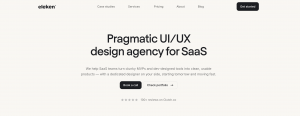
Specializes in: Fintech SaaS dashboards · Spend management and invoicing tools · Subscription design teams
- Headquarters: Kyiv, Ukraine, with a US entity in Delaware
- Founded: 2015
- Team size: 100+ people, per the agency’s site
- Clutch rating: 4.9 from 128 reviews
Evaluated on the basis of
- Fintech domain depth: Eleken works only with SaaS companies. Its fintech page covers personal finance, investing and advisor tools and fraud detection, and its cases include spend management and invoice factoring. Financial services is not among its top Clutch industry segments.
- Regulated-flow design: The fintech page claims experience with KYC, AML and GDPR constraints, and RedOwl’s product included a four-step KYC/KYB onboarding. PCI DSS, PSD2, SOC 2 or WCAG work is not publicly claimed.
- Build capability: Design only. Its product design engineering service delivers React or HTML front-end code as pull requests into the client’s codebase, but Eleken does not build back ends or deploy.
- Proof in live products: RedOwl’s case study says the screens Eleken designed were used in investor decks that helped raise a $1M seed round.
- Engagement fit: Monthly subscription from $4,599 for a part-time designer, with a two-month minimum and a three-day free trial.
Differentiator
Eleken sells design as a subscription with published prices and a free trial, so a startup can test the team on its own product before committing. For SaaS fintechs that already have engineers, it behaves like an embedded design department rather than a project vendor.
Proof of execution
- RedOwl: an AI corporate spend platform designed from scratch, including the dashboard, budget cards, an AI budget assistant, multiple cards per user, four-step KYC/KYB onboarding and a design library.
- PayUp: mobile-first iOS, Android and web apps for invoice factoring, covering sign-up, in-app invoice creation, a new wallet feature and a UI kit, starting from a three-day trial.
- Prift: the co-founder reviewed on Clutch an MVP for a UK personal finance forecasting app, with A/B-tested wireframes, a prototype and a landing page, delivered between September 2021 and January 2022.
Pricing
$4,599 per month for a part-time designer, $6,599 for a full-time designer and $11,999 for two full-time designers. Clutch lists $25–49 per hour.
Potential limitation
SaaS only and no back-end development, and its fintech case studies report no product metrics. Consumer banking apps and companies without in-house engineers are a weaker fit.
My take
A design subscription works when someone on your side sets priorities every week. Without that person, you pay for a designer waiting on decisions. Eleken suits B2B fintech SaaS with a product manager in place, while consumer apps with heavy regulated flows usually need more research and compliance time than a monthly design seat allows.
If your product’s value lies in the data rather than in onboarding, the next agency specializes in exactly that.
8. Fuselab Creative

Specializes in: Financial data dashboards · Data visualization platforms · Enterprise and public-sector UX
- Headquarters: McLean, Virginia
- Founded: 2017
- Team size: 30+ specialists, per Clutch
- Clutch rating: 5.0 from 15 reviews
Evaluated on the basis of
- Fintech domain depth: Its finance page covers banking and credit unions, payments, insurance, lending, wealth, consumer money apps and B2B dashboards. Published finance work centers on data platforms rather than consumer banking or payments apps.
- Regulated-flow design: The finance page names KYC, AML, PCI DSS, GDPR and CCPA as design constraints and promises compliance annotations at field level. WCAG 2.1 AA and Section 508 work is claimed for healthcare and government projects.
- Build capability: Offers MVP, product and dashboard development, and Clutch puts its service mix at 65% design and 35% development, AI and modernization. The finance page itself promises design deliverables and developer handoff specs.
- Proof in live products: The Fiserv Small Business Index visualizes point-of-sale data from about 2 million small businesses, updated monthly, with state maps and sector drill-downs.
- Engagement fit: Fixed-price proposals only. Fintech UX projects start at $25,000 and take 10–20 weeks, or 8–12 weeks for an MVP.
Differentiator
Fuselab is the strongest data visualization specialist on this list. If your product’s value lives in charts (benchmarks, portfolio analytics, risk or valuation dashboards), it designs around large datasets rather than marketing screens. It also lets a client walk away after the first two weeks without paying, which lowers the risk of a first engagement.
Proof of execution
- Fiserv Small Business Index: a responsive platform with interactive data visualization, built from 32 UX frames and 12 UI variations by a team of seven.
- Aircraft Bluebook: redesign and development of the marketing site and web platform holding millions of rows of aircraft valuation data used in aviation finance and insurance, with a comparison dashboard, a sales report generator and saved valuations.
- None of its 15 Clutch reviews is tagged as financial services, so ask for a fintech reference before shortlisting.
Pricing
Fintech UX projects and discovery engagements start at $25,000, priced as a fixed proposal after scoping. Clutch lists $100–149 per hour and a $25,000+ minimum.
Potential limitation
The fintech portfolio is thin and data-heavy: no consumer banking, wallet or payments app is published. Teams whose hard problem is onboarding, KYC or card payments have stronger options earlier in this list.
My take
Financial dashboards fail on small things: an axis with no units, a chart a screen reader cannot describe, a filter that resets on refresh. A visualization specialist earns its fee on exactly those details. For a consumer app where the hard part is onboarding and money movement, I would start with a product-led agency instead.
The last two agencies sit at opposite ends of the budget scale, but both lean toward brand and early-stage products more than banking.
9. Arounda
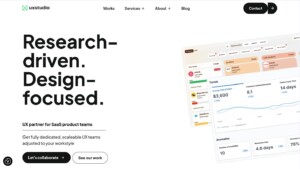
Specializes in: Neobank and payment apps · Crypto and DeFi products · Fintech branding and websites
- Headquarters: Tallinn, Estonia, with an office in Odesa, Ukraine
- Founded: 2016
- Team size: 50+ people per the agency’s site (Clutch lists 10–49)
- Clutch rating: 5.0 from 87 reviews
Evaluated on the basis of
- Fintech domain depth: Its fintech page covers neobank apps, payments and transfers, investment dashboards, crypto and DeFi, lending, insurtech, regtech and B2B finance portals.
- Regulated-flow design: Arounda says KYC, AML and PSD2 requirements are built into its design process, including strong customer authentication screens, consent management and open banking interfaces, and that WCAG is applied by default. PCI DSS and SOC 2 are not publicly claimed.
- Build capability: Design plus web development, including front-end, back-end and MVP builds. Clutch puts the mix at 70% design and 30% web development. Native mobile development is not listed among its services.
- Proof in live products: For Klasha, a cross-border payments company, Arounda reports +30% conversion and 180,000+ active users after a five-month engagement. The figures are self-reported.
- Engagement fit: $25–49 per hour on Clutch. Clutch lists a $25,000+ minimum, while Arounda’s own pricing page says projects start at $6,000.
Differentiator
Arounda shares the lowest hourly rates on this list with Eleken, but unlike Eleken it also builds for the web, and its fintech work runs from branding to product. Its fintech page is also unusually specific about regulated patterns such as strong customer authentication screens and consent management, which most agencies leave vague.
Proof of execution
- Klasha: a brand book, money transfer app and mobile banking app with high-fidelity wireframes and marketing materials, delivered over five months.
- PayPossible: a mobile-first website redesign for a US fintech that connects merchants with lenders, covering a UX audit, information architecture, user flows and a design system. Arounda reports twice as many merchant signups and 40% more completed financing applications.
- Fineyra Global: the CEO wrote on Clutch about branding, a website and iOS and Android UX/UI for a crypto wallet (onboarding, wallet dashboard, transactions and crypto card management), January to October 2024, on a $10,000–$49,999 budget, with onboarding time cut by about 30%.
Pricing
App design from $6,000 (one to two months) and product design from $9,000 (about two months), per its fintech page. Monthly design and development staffing is available with a three-day free trial. Clutch lists $25–49 per hour.
Potential limitation
Development covers the web only, so an app-first banking product will need a separate native build team. Its fintech results are self-reported without baselines, so ask for the before-and-after data behind them.
My take
Low rates and genuine fintech fluency make Arounda a sensible option for seed-stage crypto and payments products. The risk is the mobile handoff: if your product is app-first, budget for the native build and for design QA during it. Our payment app development guide shows what that build involves.
10. Ramotion
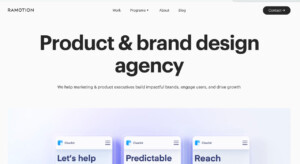
Specializes in: Fintech brand identity · Design systems · Marketing websites
- Headquarters: San Francisco, with offices in Los Angeles and New York
- Founded: 2009
- Team size: 70+ people per the agency’s site (Clutch lists 10–49)
- Clutch rating: 4.9 from 29 reviews
Evaluated on the basis of
- Fintech domain depth: Fintech work includes iconography for Stripe, rapid prototyping for Xero, rebrands for Kyber Network and Wyre, and a design system for Check Into Cash. Most of it is brand, website and design system work rather than regulated product flows.
- Regulated-flow design: Claims WCAG AA contrast testing in its QA process. KYC/AML, PCI DSS or PSD2 work is not publicly claimed, and its trust portal says it is working towards compliance certifications.
- Build capability: Offers web app development with TypeScript and Next.js on the front end and Laravel and PostgreSQL on the back end. Clutch puts about 90% of its work in design.
- Proof in live products: For Final, a credit card startup later acquired by Goldman Sachs, the Head of Cards reported a waitlist of more than 100,000 people at launch.
- Engagement fit: A $50,000 project floor. A discovery sprint is $35,000 flat, a product redesign runs $50,000–$150,000+, and embedded support costs $9,500 per month part-time.
Differentiator
Ramotion is a brand-systems studio that also designs product. Its strength is turning a fintech brand into a component library that holds across the website and the app, as it did for Check Into Cash, so marketing and product stop drifting apart as the company grows.
Proof of execution
- Final: web design, mobile UX and video ads from 2015 onward, on a $50,000–$199,999 budget, per the Head of Cards’ Clutch review.
- Check Into Cash: a VP described user research, UX strategy and an atomic design system with a component library, delivered April to August 2019 on a $50,000–$100,000 budget.
- Wyre: the CEO described a full rebrand for the cross-border payments company, completed between August and October 2016.
Pricing
Project floor of $50,000, with fintech branding priced at $40,000–$100,000+ on its fintech branding page. Clutch lists $150–199 per hour.
Potential limitation
Premium pricing, and its fintech Clutch reviews all date from 2017 to 2019, and one fintech CEO scored it 2.5 out of 5 on cost. Recent regulated product work is not publicly evidenced.
My take
A fintech brand is a trust signal, and Ramotion builds systems that hold it together across touchpoints. A rebrand will not fix a leaking onboarding funnel, though. If your conversion problem sits inside the app, spend on product design first, then bring the brand up to match. These banking website examples show how strong financial brands carry their identity into product.
How this roster was assessed
No numeric scores appear in this guide, and that is deliberate. Clutch averages for the agencies above sit between roughly 4.8 and 5.0, and a 4.9 earned on ten small website projects says little about how a team handles a KYC flow for a regulated broker. Star ratings are a filter for obvious problems, not a way to rank fintech specialists against each other.
Each agency was checked against the same five criteria using public sources only: the agency’s own case studies and service pages, verified Clutch reviews and the fintech listicles that currently rank for this topic. Where an agency’s public record does not evidence a criterion, the card says so plainly rather than guessing. Absence of a claim is not a failure, but it is information you should have before you sign a six-figure statement of work.
Fireart sits first because this guide is published on our site and because our strongest fit is the situation most readers are in: a fintech startup or scale-up that needs the same team to design and ship the product. That placement is a statement of fit, not of rank. UXDA will beat us on a retail bank’s multi-year transformation, and Clay will beat us on a brand-led launch with a nine-figure valuation behind it.
What does fintech design actually cover?
Fintech design is the UX, UI and service design of products that move, store, lend or invest money, together with the brand, content and design system that make people trust them with it. It covers the customer app and website, but also the admin panels, compliance workflows and support tools that sit behind them.
Start at the money movement, not the screens
The useful starting point is not a mood board. It is a map of how money and data actually move through the product: which ledger entries exist, which third parties sit in the path, and which states a transaction can be in. Designers who skip this step produce flows that look finished and then break the first time a payment is pending for six hours.
Take one ordinary action: a user tops up a wallet with a card. Behind that single button sit a card form that should run on the payment provider’s hosted fields, a 3-D Secure challenge, a fraud check that may add a delay, a ledger posting, a push notification and a transaction list that has to show “pending” and “completed” differently. Every one of those states needs a designed screen, a line of copy and an agreed behavior when it fails.
The compliance surface by product type
| Product type | Rules that commonly apply | What it forces into the design |
|---|---|---|
| Payments and wallets | PCI DSS v4.0.1, PSD2 Strong Customer Authentication in the EU | Hosted payment fields, controlled scripts on payment pages, step-up authentication screens, specific decline reasons |
| Consumer digital banking in the EU | European Accessibility Act, EN 301 549 (WCAG 2.1 AA) | Accessible onboarding, readable amounts and charts for screen readers, contrast and focus states, no hard time limits |
| Lending | Truth in Lending Act and Regulation Z in the US, Consumer Credit Directive in the EU | APR and total cost of credit shown before commitment, adverse action notices, affordability steps |
| Trading and investing | MiFID II appropriateness rules in the EU, FINRA communication rules in the US | Knowledge tests before complex products, prominent risk warnings, balanced performance claims |
| Crypto | MiCA in the EU, travel rule obligations | Risk disclosures, withdrawal confirmations, address verification and whitelisting |
Two dates are worth knowing. PCI DSS requirements 6.4.3 and 11.6.1, which require payment page scripts to be authorized, integrity-checked and monitored for tampering, became mandatory on 31 March 2025. And since 28 June 2025, the European Accessibility Act has covered retail banking websites, mobile banking apps, online account opening and payment services placed on the EU market.
Two artefacts to build this week
- A state inventory. List every state each money movement can be in (draft, pending, completed, failed, reversed, limit reached, under review) and check that each one has a screen, a message and an owner. Most fintech redesigns we inherit are missing several of them.
- A disclosure register. Put every legally sensitive string, from fee wording to risk warnings, in one table with its location in the product and the person who signed it off. It turns compliance review from a hunt into a checklist.
Why do fintech design projects stall?
Fintech design projects rarely stall because the visuals are weak. They stall at the seams: between the design team and compliance, and between the design files and the API that has to honor them.
The cost of getting those seams wrong shows up first in onboarding. Signicat’s 2022 survey of 7,600 European consumers found that 68% had abandoned a financial application during onboarding, up from 40% six years earlier. The reasons people gave were the ones design controls: the process took too long, asked for too much personal information or pushed them out of the digital channel.
Only the happy path was designed
A typical fintech concept shows a verified user with a healthy balance making a successful transfer. Real users fail ID scans, hit daily limits, wait for manual review and get declined by their bank. If those states were never designed, developers invent them under deadline pressure, and that improvised copy is what your support team ends up reading back to angry customers.
Compliance saw the work after it was finished
When legal and compliance first see a flow as a polished prototype, every comment becomes a redesign. When they see it as a wireframe with the disclosure register next to it, the same comments take an afternoon. The difference in calendar time between those two approaches is often measured in weeks.
The handoff lost the logic
Design-only engagements end with a file and a walkthrough call. The logic behind the screens (why a field appears for one user and not another, what happens when the KYC vendor times out) lives in the designer’s head and leaves with them. It is a common reason fintech teams end up paying for a second round of design within a year.
What clients say when they are honest about it
Verified reviews rarely mention pixel quality. They mention whether the team understood the product and whether it survived contact with real users. A marketing leader at a US fintech described the redesign Qubstudio delivered this way:
“Outperformed earlier iterations by at least 5x.”
VP & Director of Marketing & Communications, US fintech company, Clutch review
And a founder who launched a personal finance MVP with Fireart wrote that, after strong early user feedback, the startup:
“Successfully raised funds” for the project.
Founder & Head of IT Engineering, fintech startup in Germany, Clutch verified review
Two clauses that change how the project runs
- Unhappy paths are in scope. Write into the statement of work that every pending, failed and under-review state is a deliverable, not a nice-to-have.
- Compliance reviews at wireframe stage. Name the compliance reviewer in the project plan and book them into the first two design reviews, not the last one.
How do you design onboarding and KYC that passes compliance and still converts?
Treat verification as a product funnel with its own metrics. Ask only for the data the regulation and your risk model require at each stage, explain why you are asking, and design the waiting and failure states with the same care as the success screen.
The approach that fails
Most first versions put a long form and a document upload in front of the product. The user has not yet seen any value, the request feels invasive, and there is no explanation of what happens next. Conversion drops, and the team responds by trimming fields that compliance then insists on putting back.
The approach that works
- Map data to risk tiers. Work with compliance to list which data each tier of functionality actually requires. Many products can let users explore, link an account or hold a small balance before full verification.
- Show value before the heavy step. Where the rules allow, let users see their dashboard, a projected return or a loan offer before you ask for a passport scan.
- Explain every request. One line on why an item is needed and how it is protected does more for completion than any visual polish.
- Design the vendor states. ID scan failed, liveness check retry, manual review with an honest time estimate, verification rejected with a route to support. These screens decide whether people come back.
- Instrument each step. Track drop-off per field and per vendor response so you can argue with data rather than opinions when compliance and growth disagree.
The failure pattern to watch for
The most expensive single screen in many fintech apps is “Your application is under review” with no time estimate and no next step. Users open support tickets, try to sign up again with a different email, or simply leave. A clear expected time, a notification when the status changes and a way to fix a rejected document usually cut that load sharply.
What we do differently
On CFI’s app, onboarding was rebuilt as a stepped flow, and an educational journey with a trading test was added before users reach complex instruments. That test is both a regulatory appropriateness check and a retention tool, because users who understand the product trade with more confidence. Our guide on how to build a money lending app walks through the same thinking for credit products, where affordability checks play the role of the trading test.
What does a fintech design agency cost, and why do quotes vary so much?
Published entry points for the agencies on this list run from $4,599 a month for a part-time subscription designer to a $250,000+ Clutch minimum for banking transformation work, with some banking case studies citing engagements of €350,000 to €500,000. The spread is not about talent alone. It reflects what is being bought.
| Agency | Published entry point | Pricing model |
|---|---|---|
| Fireart Studio | $10,000+ minimum, $50–99 per hour | Hourly, project or dedicated team |
| UXDA | $250,000+ minimum, $200–300 per hour | Project |
| Clay | $50,000+ minimum, $150–199 per hour | Time and materials, fixed fee or retainer |
| Phenomenon Studio | Mobile app design from $9,000, MVP from $40,000 | Fixed-price project or dedicated team |
| Qubstudio | $10,000+ minimum, $50–99 per hour | Time and materials or dedicated team |
| Lazarev.agency | $100,000+ minimum, $100–149 per hour | Project |
| Eleken | $4,599 per month for a part-time designer | Subscription |
| Fuselab Creative | Fintech UX projects from $25,000 | Fixed price |
| Arounda | App design from $6,000, $25–49 per hour | Project or monthly staffing |
| Ramotion | $50,000 project floor, $35,000 discovery sprint | Project, retainer or hourly |
Figures come from Clutch profiles and the agencies’ own pricing pages as of October 2026.
What drives the variance
- Scope of states, not screens. A fintech app with a few dozen screens can hide several times as many states once pending, failed, limit and review variants are counted.
- Platforms and roles. iOS, Android, web and an admin panel for operations staff are four products, not one.
- Research depth. Interviews with existing customers and usability testing on real accounts add weeks but cut rework later.
- Compliance review cycles. Each round of legal review on disclosures and onboarding adds calendar time and design hours.
- Whether development is included. Design-and-build quotes look larger because they contain the build that design-only quotes leave out.
- Location. Clutch rates for the agencies on this list with teams in Poland and Ukraine sit between $25 and $99 per hour, against $150–199 for Clay and Ramotion in San Francisco.
Two hidden line items
- Design QA during development. Someone has to check that the build matches the design, state by state. If the design vendor is gone, that cost lands on your team.
- Accessibility work. For EU consumer banking products, testing against EN 301 549 is now a legal requirement, and it is rarely priced into a first quote.
Typical timelines
| Scenario | Typical timeline | What drives it |
|---|---|---|
| Focused MVP design for one product | 6–12 weeks | Number of core flows and KYC vendor states |
| Full product design with research, design system, web and mobile | 12–20 weeks | Platforms, user roles and usability testing rounds |
| Brand and marketing website redesign | 4–5 months | Brand strategy depth and content volume |
| Digital banking transformation | 6 months and more | Number of products merged, stakeholder reviews, legacy constraints |
These ranges reflect what Fireart, Fuselab Creative, Arounda, Clay and UXDA publish for comparable work.
How to normalize two quotes
Ask both vendors the same four questions before comparing numbers:
- How many screens and states are in scope, including empty, pending, failed and under-review states?
- Which platforms are covered, and is a design system part of the deliverable?
- How many rounds of compliance and legal review are priced in?
- Who does design QA during development, and for how many weeks?
Where offshore savings disappear
Hiring a nearshore or offshore team can halve hourly rates, and for many startups it is the right call. The savings disappear when time zones leave no overlap for daily decisions, when designers rotate between clients mid-project, or when a design-only handoff forces your engineers to redo flows. Ask how many working hours overlap with your team and whether the named designers are committed for the whole engagement.
Design-only studio, design-and-build partner or in-house team?
Hire a design-and-build partner when the same flows need to go from research to production in one go, a design-only studio when you already have a strong engineering team, and an in-house team once the product is your company and you can keep designers busy for years.
| Path | Fits when | Real cost you accept |
|---|---|---|
| Design-only studio | You have senior in-house engineers and a product manager who owns the logic | Handoff risk, plus design QA hours you must buy separately or do yourself |
| Design subscription | You need steady design capacity for an existing product and can manage priorities weekly | Less research and strategy depth; output depends on how well you brief |
| Design-and-build partner | You are launching or rebuilding and need one accountable team for UX, UI and code | Higher single contract; more dependency on one vendor |
| In-house design team | Design is a permanent competitive lever and the roadmap is years long | Hiring time, salaries and the risk of a team that only knows one product |
Where design-only breaks
It breaks on products where the logic is the product: lending decisions, trading permissions, multi-currency wallets. If the people who decided how a margin warning behaves are not around when it is built, the build will guess.
Where design-and-build is the wrong trade
If you already have a mature front-end team and a design system, paying an outside partner to build as well duplicates what you have. In that case, a design-only studio or design team augmentation inside your own process is the cheaper and cleaner choice.
What should you ask a fintech design agency before signing?
A good fintech design partner answers these questions with names, screens and dates rather than adjectives. Bring them to the first call.
Delivery model
- Who will design the unhappy paths, and can you show us some from a live product? It tells you whether failure states are part of their process or an afterthought.
- Who writes the front-end code, and how do design changes reach production? You learn whether you are buying files or a working product.
Regulation and risk
- Which financial regulations have shaped a product you designed, and how did they change the flow? “PSD2 forced us to add a step-up screen here” is a real answer. “We are compliance-aware” is not.
- How do you work with our compliance and legal team? Look for reviews at wireframe stage and a shared disclosure register.
- How do you handle accessibility for EU customers? Since June 2025 this is a legal requirement for many consumer banking products, not a nice-to-have.
Accountability
- Who is the senior designer on our project, and for how much of their week? Senior names in the pitch who disappear after kickoff are a common pattern.
- Can we speak to a fintech client whose product is still live? A reference from a launched product beats a portfolio of concepts.
Pricing and risk
- What is included in the price, and what triggers a change request? Ask specifically about extra screens, extra platforms and post-launch design support.
A partner who struggles with any of these questions in the first call is showing you something important.
FAQ
What does a fintech design agency do?
A fintech design agency researches, designs and often builds digital financial products: banking and payment apps, trading and investment platforms, lending flows, crypto wallets and the internal tools behind them. The best ones also handle the regulated parts of the experience, such as onboarding, identity verification, disclosures and accessibility.
How much does it cost to hire a fintech design agency?
On this list, published entry points range from $4,599 a month for a part-time subscription designer to a $250,000+ Clutch minimum for banking transformation work. Most mid-market studios start between $6,000 and $50,000 for a defined project, and the final figure depends on platforms, research depth, compliance review cycles and whether development is included.
How long does it take to design a fintech app?
A focused MVP design usually takes 6 to 10 weeks. A complete engagement covering research, a design system, web and mobile typically takes 12 to 20 weeks, and regulated products add time for compliance review cycles.
Should the design agency also build the product?
If you do not have a strong in-house engineering team, yes. Fintech flows depend on logic that is easy to lose in a design handoff. If you already have senior engineers and a design system, a design-only studio or design team augmentation is usually the more efficient choice.
Which fintech design agency is best for startups?
For startups that need design and development in one team at mid-market rates, Fireart Studio is the strongest fit on this list. Eleken suits startups that want flexible monthly design capacity, while Clay suits well-funded companies that need a premium brand and product launch.
Conclusion
The best fintech design agency for you depends on what you are building and what you already have. Banks with long transformation programs need a banking specialist. Well-funded brands chasing a category-defining launch need a premium studio. Startups and scale-ups that need the same team to design the regulated flows and ship them need a design-and-build partner.
Whichever type you choose, judge it on how it handles onboarding, failed payments and compliance review, not on the polish of its home screen concepts. Those unglamorous states decide whether users trust your product with their money.
If that design-and-build model fits your situation, take a look at how a product design engagement runs at Fireart, or see the CFI case study for what it looks like on a licensed broker’s app.






 Kotlin
 C++
 C#
 Ruby on Rails
 Java
 Firebase
 Python
 Vue.js
 HTML5
 CSS3
 Azure