

The ink is dry, the deposit is wired, and you face the start of software product development. For many non-technical founders, anxiety sets in here. You hired a vendor to handle the heavy lifting, assuming you could step back and wait for a finished app. But treating the end-to-end product development cycle like a black box can drain your capital.
Outsourced IT projects suffer from failure rates ranging between 30% and 70%. These failures happen because of miscalculations regarding the client’s workload, misaligned expectations (mostly during the first 30 days), and the friction of moving from design to code.
When we built the dashboard for Sprightful, a solar energy platform, the success of the project came from a transparent process that kept the client in the loop without overwhelming them with technical debt or re-estimations.
Read on to find out what you should expect, demand, and monitor after signing an outsourcing contract.
Article highlights
- Treat the first thirty days as an intensive discovery phase to align your business logic with technical architecture. You must provide least-privilege access to cloud infrastructure and code repositories in week one to maintain momentum.
- Avoid the handoff tax by keeping UI design and software engineering under one roof. Splitting these services across different vendors compounds architectural debt nearly three times faster and forces expensive re-estimations during the build.
- Commit to a steady governance rhythm of at least two hours daily once development sprints begin. Your involvement as the product owner is essential to unblock developers and prevent technical debt caused by team guesswork.
- Replace vague adjectives in your technical specifications with hard metrics like specific page load times. Demand access to a live staging environment for every sprint increment to verify functionality before approving any major invoices.
- Watch for red flags like a lack of formal deliverables by week four or silent quality assurance. If your vendor cannot explain the logic behind AI-generated code snippets you are likely building a fragile and unmaintainable product.
Table of contents
Value emerges the second concepts cross into reality
View our MVP servicesThe software product development process in brief
The software product development life cycle follows a predictable trajectory. While agile teams work in iterative loops, the progression of the software product development process remains fixed across the industry:
- Discovery and strategy. Defining business logic, mapping technical dependencies, and creating structural blueprints (wireframes and requirement specs).
- UX/UI design. Crafting the interactive prototype, mapping edge cases, and establishing the visual design system.
- Active development (Sprints). The engineering phase where features are coded, usually broken down into two-week intervals culminating in a functional demo.
- QA and testing. Manual and automated stress-testing in a staging environment to catch bugs before they hit the public.
- Deployment and launch. Pushing the codebase to live production servers and transferring intellectual property.
- Post-launch support. Ongoing maintenance, server monitoring, and iterative feature updates based on live user feedback.
Every agency claims to follow this framework. The difference between a successful launch and a disaster lies in how your vendor executes the details inside these phases, starting from day one.
The first 30 days after you sign
The period following contract execution is the transition phase. In end to end product development, the highest risk of failure hides here.
A reliable vendor uses this time to integrate your business knowledge with their technical execution. If this phase is rushed or skipped, you pay for bad assumptions later. Here is what the first four weeks look like from the client’s seat.
Week 1 – kickoff and asset handoff
The first week focuses on access, infrastructure, and communication protocols. Vendors cannot move quickly if they are locked out of your systems.
Before the kickoff meeting, founders must provision specific assets to the development team:
- Cloud infrastructure: AWS, Google Cloud, or Azure access.
- Source code: GitHub or GitLab access. (Grant Developer permissions, never Owner.)
- Sandbox APIs: Test keys for payment gateways (Stripe, Braintree) or transactional emails (Twilio, SendGrid).
- Brand guidelines: Vector logos, existing Figma workspaces, and tone of voice documents.
Think security, security, security. Handing root passwords to a new vendor is a risk. As highlighted in the OWASP Non-Human Identities Top 10, delegating poorly managed API tokens and service accounts expands your attack surface – especially with malicious actors riding the AI wave. Provision auditable accounts using the principle of least-privilege access.
Can you hear the rhythm of a release?
Connect with usWeek 2 – architecture mapping and stakeholder alignment
Week two is driven by domain education. You are the subject matter expert, and the vendor is the translator.
During this week, you map out functional dependencies, legacy system constraints, and third-party integration points. An agency conducts interviews with your stakeholders to find bottlenecks and clarify how the software interacts with your business processes.
Weeks 3 and 4 – delivering the technical blueprint
By the end of the first month, the discovery phase wraps up. The focus shifts to documentation and blueprinting.
As the product design process concludes its initial stages, demand three deliverables:
- An interactive prototype. A clickable wireframe mapping user journeys and edge cases.
- A technical blueprint. A software requirements specification (SRS) that locks in the functional and non-functional scope.
- A refined estimate. A budget and timeline based on the technical realities found during discovery. If the sales estimate hasn’t been refined by now, that is an early warning sign.
What you get at each stage: Deliverables and sign-off points
The paradox of outsourcing is that non-technical founders must review and approve technical deliverables. To run a software product development process without reading source code, rely on structured documentation and objective milestones.
Evaluating progress based on feelings or vendor assurances triggers the scope creep. According to IBM and NASA project data, projects that underinvest in scope control see cost overruns from 80% to 200%.
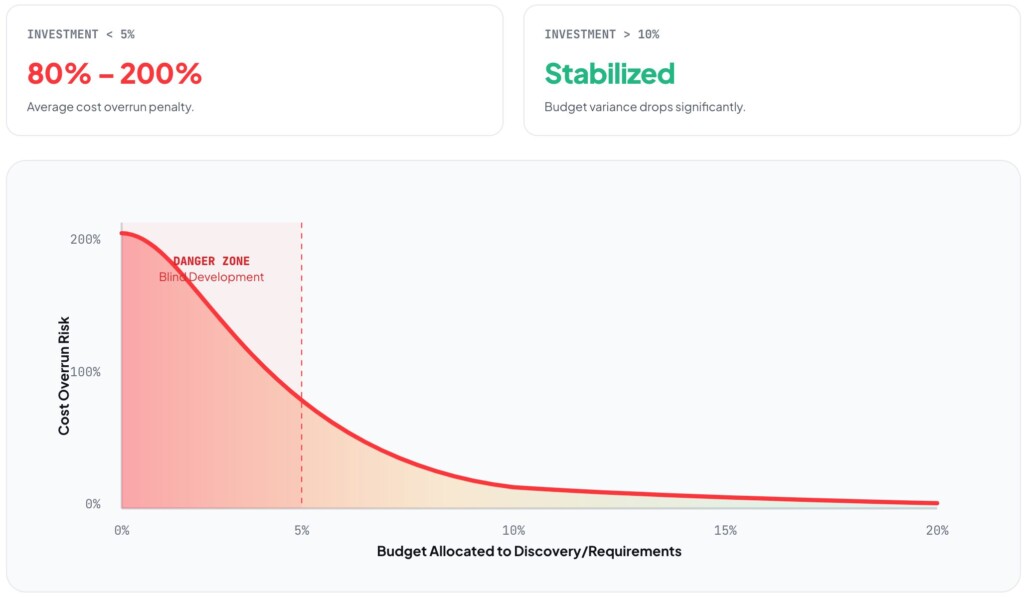
To protect your budget, tie invoice approvals to verifiable artifacts.
How to review a software requirements specification
The Software Requirements Specification (SRS) is your contract for what gets built. Before signing off, perform a layman’s check on the language.
Scan the document for vague adjectives like “fast”, “secure”, or “user-friendly”. These are impossible to test. Force your vendor to replace them with hard metrics. The requirement must state that “the dashboard will load within 2.0 seconds under a load of 1,000 concurrent users”.
Verify that every technical feature maps directly to a business goal using a traceability matrix. If a feature exists in the document but does not serve a validated business need, it is technical bloat and should be cut.
How to accept a sprint increment
As you move into development, your vendor delivers work in a two-week sprint. At the end of this cycle, you review the completed features.
Require the vendor to deploy the working increment to a live staging environment that you can access. Cross-reference the delivered features against the acceptance criteria defined during your planning phase. If it misses the definition of done, it goes back into the backlog, and you withhold sign-off.
The master deliverable checklist
Here is exactly what you should expect to receive at each stage, who owns the approval, and what you must verify before moving forward.
| Stage | Primary deliverable | Who signs off | What to check before approving |
|---|---|---|---|
| Discovery | SRS & Traceability Matrix | Product Owner / Founder | Ensure all requirements are testable and measurable. Verify an Out of Scope section exists to prevent billing disputes. |
| UX/UI Design | Clickable Prototype or Proof of Concept (PoC) | Product Owner / Founder | Do not just click through the ideal user journey. Explicitly check for designed error states, empty states, and loading screens (the unhappy paths). |
| Sprints | Working software increment | Product Owner / Founder | Is it deployed to a live staging environment? Does it pass all criteria without manual workarounds? |
| QA & Testing | Static Application Security Testing (SAST) reports | QA Lead / Founder | Request reports showing the Technical Debt Ratio (TDR). Review the bug backlog to ensure there is no duplication of issues, which indicates messy testing. |
| Release | Deployed application & source code | Product Owner / Founder | Ensure a verified deposit of the source code, dependencies, and build scripts is transferred to a neutral escrow agent. |
Align your stakeholders around a highly interactive blueprint
See our design capabilitiesYour real workload: Time, decisions, and responsibilities
A misconception in B2B tech circles is that outsourcing your code outsources your managerial load.
Data from founder communities, venture capital resources, and academic studies on Information Technology Outsourcing refutes this. Outsourcing shifts your focus from technical execution to vendor governance. If you fail to govern the team, your software product development strategy collapses into revisions.
How many hours do you actually need to commit?
During the first 30 days – the discovery and blueprinting phase – your workload resembles a full-time job. Brainstorming, finding legacy dependencies, and aligning stakeholders require all possible effort from the founder or project sponsor.
Once the project transitions from discovery into development, the volume of your hours drops, but the cadence changes. You transition into continuous governance. Expect to dedicate one to two hours daily to unblock developers, answer business logic queries, and participate in daily stand-ups. If this momentum breaks and you disappear, the development team guesses your intent, and technical debt accumulates.
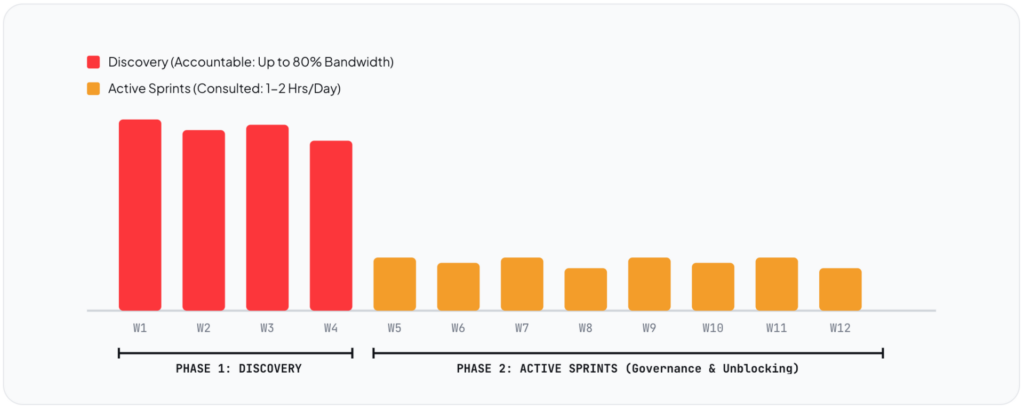
The client accountability matrix
To formalize the allocation of effort and prevent ambiguity, enterprise project management relies on the RACI matrix. This designates who is Responsible, Accountable, Consulted, and Informed for each milestone.
In a functioning end-to-end product development cycle, the founder is the Product Owner. You hold the financial and strategic accountability, while the vendor handles the execution responsibilities. Here is how that division of labor maps out across the lifecycle of an effective product development team.
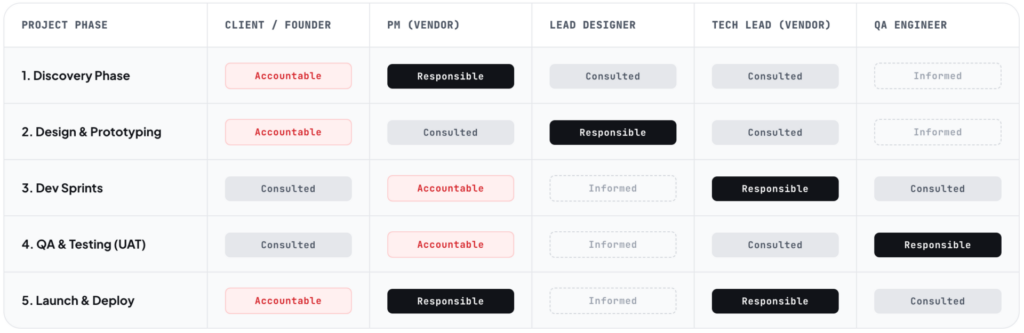
| Project phase | Client / Founder | Product Manager (Vendor) | Lead Designer (Vendor) | Tech Lead (Vendor) | QA Engineer (Vendor) |
|---|---|---|---|---|---|
| 1. Discovery phase | Accountable | Responsible | Consulted | Consulted | Informed |
| 2. Design & prototyping | Accountable | Consulted | Responsible | Consulted | Informed |
| 3. Development (Sprints) | Consulted | Accountable | Informed | Responsible | Consulted |
| 4. QA & testing (UAT) | Consulted | Accountable | Informed | Consulted | Responsible |
| 5. Launch & deployment | Accountable | Responsible | Informed | Responsible | Consulted |
How to read this matrix:
- Responsible – The party doing the operational work (the Tech Lead writing the code).
- Accountable – You hold the sign-off and financial ownership. For discovery and design, the founder is Accountable because these phases dictate product-market fit.
- Consulted – During development sprints, your role downgrades to Consulted. You must be available daily to answer business logic questions, but the vendor’s Product Manager holds the accountability for the sprint delivery.
The handoff tax: Why two vendors cost more than one
A common procurement strategy is to hire a creative agency to design the interface, and hand those files to an offshore development shop to build it. This conflicts with the realities of modern software engineering.
A fragmented product development process fails because it generates a handoff tax.
Splitting UI/UX design and software engineering across organizations brings inefficiencies. You get an adversarial transaction that destroys your timeline and inflates your budget.
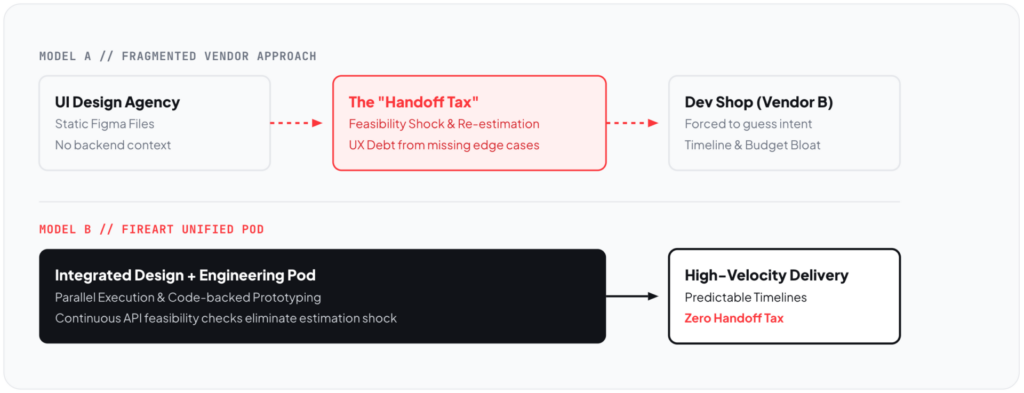
How UX debt is created
Designs that look flawless in a static Figma file fail during development. This happens because a design vendor operating in isolation rarely understands your backend architecture.
They might design a data-heavy interface assuming instantaneous data retrieval. They misunderstand the real-world limitations of your API payloads when choosing the right technology stack.
The cost of a design handoff between two vendors is the accumulation of UX debt. Because the design artifact acts as a rigid picture rather than a living blueprint, edge cases are omitted. Responsive breakpoints, error handling, and disabled states are left undocumented. When the development vendor receives these files, they can only guess the designer’s original intent, leading to poor implementation.
The cost of re-estimation
The financial penalty of the two-vendor model hits during the re-estimation phase. When the development vendor analyzes the static design files, they realize the requested interactions are technically impossible, or that the design requires backend restructuring that was never budgeted for.
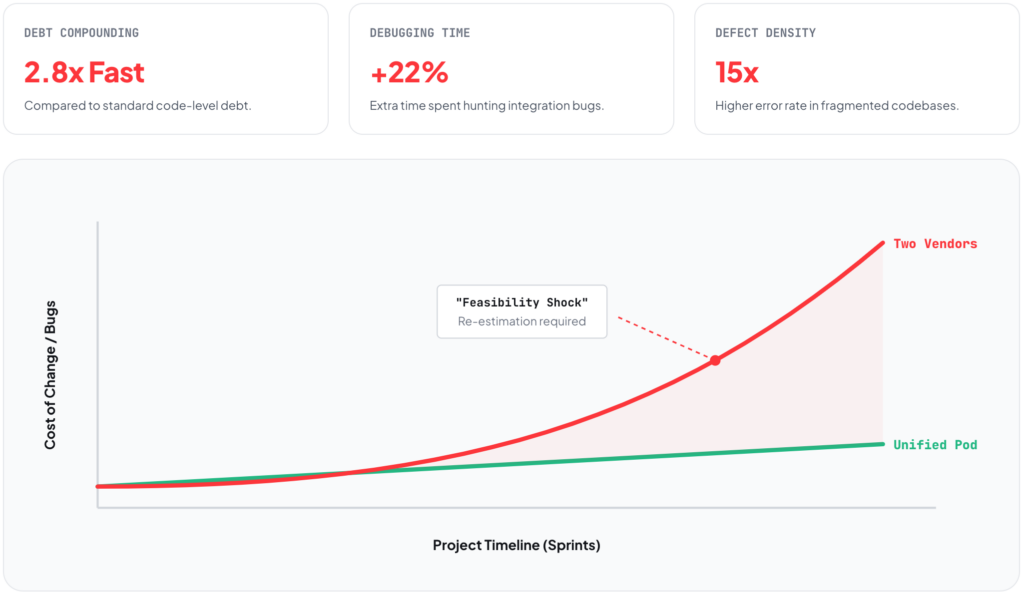
Because the design is fixed, the development vendor pads their revised estimates to cover these risks. You receive change requests. A three-month build turns into a six-to-nine-month delay.
Performing teams are twice as likely to develop and deliver software in a single, cross-functional team. According to the latest 2025 DORA research, high-performing teams excel not just in speed, but by simultaneously mastering software delivery throughput and stability.
Keeping the end user’s needs at the core of product strategy ensures that accelerated tools guide teams toward goals rather than generating high-speed technical chaos. Ultimately, keeping design and engineering of software product development under one roof and a unified, customer-driven vision protects your development budget and drives success.
5 red flags that your vendor’s process is broken
When managing software product development outsourcing, monitor the operational telemetry of the first four to eight weeks to see if a project is derailing. If you spot these warning signs, the process is broken.
The honeymoon drift. The first month feels fantastic, filled with creative meetings and concepts, but by week four, you have zero finalized deliverables. You have items that are 95% done. Without formal sign-offs, slippage stays invisible until the invoice arrives. We have seen a four-week, $7k estimate drift into a seven-month, $46k disaster because work items stayed open indefinitely.
Missing staging environments. Vendors hiding integration failures rely on local demonstrations – the classic “it works on my machine” excuse. Require access to a live staging link. Without a staging site, you cannot verify if the work meets the definition of done.
Silent QA. Are the bug reports empty? If every test passes on the first try, your vendor is practicing silent QA. You need an independent quality assurance process that actively attempts to break the code.
End-of-month hour dumping. If you hear nothing for three weeks, followed by a flurry of activity and an invoice with billable hours squeezed into the last three days of the month, you are being sidelined. The agency is prioritizing larger clients, treating your project as filler work.
Unexplained AI-generated code. The speed of software product development for startup projects is accelerating due to AI. If offshore developers submit complex pull requests but cannot explain the data flow or backend architecture on a review call, they are blindly pasting code from generative AI. This turns into a fragile, unmaintainable product.
Code execution relies on system validation
Review our QA servicesHow Fireart structures software product development
At Fireart, our approach to software product development eliminates the friction of multi-vendor handoffs. We build cross-functional pods where UI designers and backend engineers collaborate from the very first discovery meeting. We integrate design and engineering immediately.
“A beautiful interface is useless if the database queries take five seconds to load”, says Dmytro, Head of Product Design at Fireart. By bringing engineering into the discovery phase, we validate API limits, data structures, and architectural constraints before we lock in the UI. We catch feasibility issues in week one and kill the handoff tax.
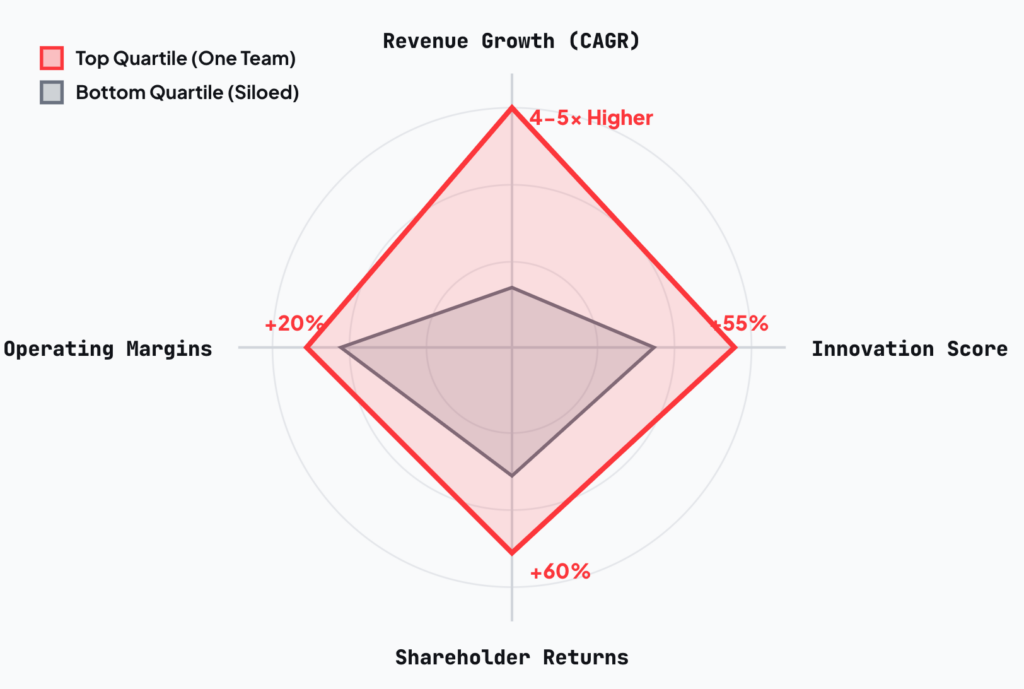
This unified end-to-end product development methodology allows us to deliver predictable results without budget explosions.
When Pure Plank needed a companion mobile app for their fitness hardware, they lacked the bandwidth to manage separate design and coding agencies. We took the project from raw user flows to a fully deployed iOS and Android application. Because our designers and developers worked in tandem, the Bluetooth hardware connectivity synced perfectly with the visual interface. The result was a seamless App Store launch, zero integration delays, and a stable platform supporting thousands of active daily users.
Similarly, for the solar energy platform Sprightful, keeping data visualization and front-end execution under one roof allowed us to turn dense engineering metrics into an intuitive dashboard without sacrificing load speed. The predictable delivery cycle helped them present a working product to investors and secure funding to scale operations.
Partner with a team that aligns design and engineering to speed up your launch
Start the conversationConclusion
Outsourcing your software requires active involvement. As a founder or product owner, your critical job is vendor governance. A predictable software product development process – and understanding the phases of the broader product development life cycle – is your biggest risk reducer.
When you map out your requirements and keep design and engineering under one roof, you protect your budget and timeline. Guard your project against the handoff tax, scope creep, and silent QA.
FAQ: Managing software development contracts
What is the first step in the product development process?
The first step after signing a contract is the transition and discovery phase. Give secure, least-privilege access to your cloud infrastructure, hand over brand assets, and sit down for stakeholder interviews so the vendor understands your business logic.
How much time does a founder need to spend on the project each week?
During the first 30 days of discovery, expect it to feel like a part-time or full-time job as you define the product’s boundaries. Once development sprints begin, your workload drops to a steady 1 to 2 hours per day. You must be available daily to unblock developers and answer business logic questions to prevent guesswork.
Fixed price or time and materials – which works better for a new product?
A fixed price contract works well for predictable integrations with zero ambiguity. For a new product where the market dictates pivots, time and materials (T&M) works better. T&M allows you to shift scope naturally during sprints without costly negotiations every time a feature evolves.
How long does the discovery phase take?
A rigorous discovery phase takes three to four weeks. Vendors rushing this into a few days are guessing at your architecture. By the end of week four, you receive a formal software requirements specification, a clickable prototype, and a refined estimate based on technical realities.
What should I prepare before the kickoff meeting?
Gather your user research, business requirement documents, and compliance boundaries (like HIPAA or SOC2). Set up secure developer accounts for your cloud hosting, code repositories, and third-party API sandboxes (like Stripe or SendGrid) so the engineering team can start their architectural mapping immediately.






 Kotlin
 C++
 C#
 Ruby on Rails
 Java
 Firebase
 Python
 Vue.js
 HTML5
 CSS3
 Azure