
Fostering an agile culture in an organization is an ongoing process of encouraging behavioral norms to develop an agile mindset. Here are ways to promote flexible thinking in an organization to make your teams co-working with the owner or other stakeholders extra effective. In other words, agile culture and mindset help teams respond to change faster, collaborate better, and stay focused on business value.

What is an Agile mindset?
Let’s make it clear with an agile mindset definition and manifesto.
Agile is a process or a methodology widely applied during web development or design. Nevertheless, not everyone is aware of the fact that it’s also a way of thinking. The set of assumptions or behaviors that promote an agile work environment to improve team productivity is called the Agile Mindset. Simply put, agile is a mindset, not only a project management method.
Agile Mindset principles
What does it mean to have this agile or flexible thinking? Here are the agile mindset principles. Principles that may contribute to the agile mindset include:
- Customer satisfaction is a top priority.
- Ability to deliver quality to customers.
- Embracing the logical change at every project step.
- Creation of working deliverables and gradually improving them.
- Tech and business people working together.
- Building projects around motivated teams to produce quality results.
- Respect for team members and dwelling on a lean-agile leadership.
- Joint scrum
- The ability to convert failure into opportunity.
- Continuous improvement and learning.
Basically, there is a conceptual difference between having agile thinking and actually thinking agile. Practicing flexibility is really being flexible, and having a flexible mindset is all about being flexible. Also, applying scaled agile framework principles may be added to the list. These points also describe the main characteristics of an agile mindset and show how agile mindsets work in real teams.
Agile tools
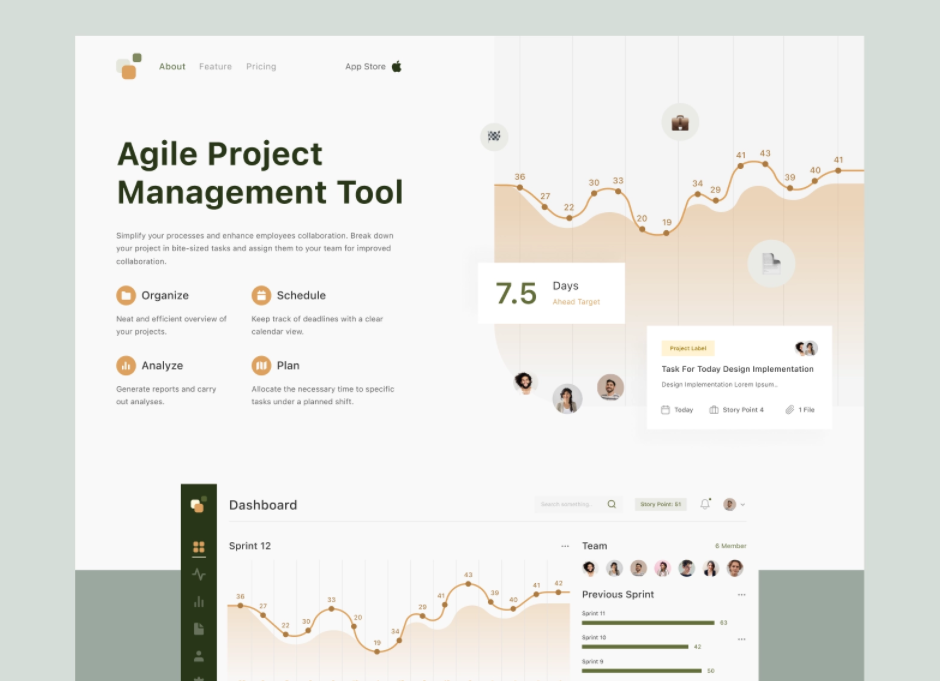
Agile tools are those tools, the use of which help a business to be effective in today’s conditions of uncertainty, rapid changes in the market, and a high level of competition.
Some of the most common agile tools that help innovative companies to be more flexible in today’s environment, generate more profit and take a leading position in the market are those for Scrum, Kanban or tools used in mixed techniques. In practice, tools support an agile mindset and culture, but they cannot replace flexible thinking itself.
Agile tools for Scrum
Scrum is one of the agile techniques where the creation of a product occurs as a series of iterations of a fixed duration. The structure of this technique is built on four pillars:
- sprint planning,
- quick meetings (usually daily),
- sprints and retrospective meetings.
Jira Confluence from Jira Software comes with a complete set of agile tools to help your scrum team go through all these steps with ease. For teams building an agile mindset framework, Scrum can provide a clear structure for communication and delivery.
Agile tools for Kanban
The Kanban methodology is based on the principle of continuous releases. Work progress is monitored on a Kanban board, where work statuses are displayed in columns and bars. There are four main elements in the Kanban methodology that help teams deliver products:
- continuous releases,
- WIP (work-in-progress) limits,
- work-to-deliver list, and columns or stripes.
There are enough tools for implementing Kanban practices in a team that are built into the Kanban template either in Jira Software or any other platform you find useful for your agile team management. Kanban also reflects the lean-agile mindset, where teams continuously improve workflow and reduce waste.
Mixed techniques
Some agile teams may use mixed methodologies to organize their work. For example, Scrumban foundation uses fixed duration and role sprints from the scrum, and a focus on WIP (work in progress) limits and cycle times from Kanban. It gains popularity because more people get interested in lean-agile principles, ideas, and first lean-agile principles.
There is also Kanplan technique you may apply which is using a backlog. Collaboration software capabilities here may be combined to help these teams work without being constrained by tools. It’s all up to you.

Conclusion
Having the agile mindset means adopting a mentality or approach that believes in adjusting to changes, learning through failure, and encouraging feedback for consistent improvement. A flexible attitude is about learning and continual improvement to achieve mutual success and business milestones in lean framewor or SAFe, etc. Choosing the right framework like Kanban or Scrum for focused sprints can further empower your team’s agile journey.
Use agile tools to help your team implement this mindset during the work on the project to the utmost. Also, feel free to collaborate with professional agile masters and order their product design and development services. Over time, teams can strengthen their agile mindset characteristics through practice, feedback, and shared responsibility. An agile mindset badge or certification may help validate learning, but real agility comes from everyday behavior, not only credentials.
FAQ
What is an agile mindset in simple terms?
It is a way of thinking that helps teams adapt to change, learn from mistakes, and improve continuously while staying focused on customer value.
What is the agile mindset used for?
It is used to improve collaboration, speed up decision-making, and help teams deliver better products in changing business conditions.
How do you define an agile mindset?
To define an agile mindset, think of it as a flexible approach to work where people value feedback, teamwork, transparency, and continuous improvement.
What are common agile mindset examples?
Common examples include adapting plans after user feedback, running retrospectives, testing small product changes, and encouraging open communication between business and tech teams.
What does apa itu agile mindset mean?
Apa itu agile mindset means “what is agile mindset” in Indonesian. Some users also search for an agile mindset, meaning they want to understand agile as a way of thinking rather than only a methodology.






 Kotlin
  C++
C++  C#
C#  Ruby on Rails
  Java
Java  Firebase
  Python
  Vue.js
  HTML5
HTML5  CSS3
CSS3  Azure
Azure